
Walking down the hallway in a warm Brevard County home only to find a thermostat blank screen usually means your air conditioning or heat pump control circuit has lost power—not necessarily that the wall unit itself has failed. Most modern residential thermostats draw continuous 24-volt alternating current from a small transformer inside your indoor air handler, while built-in safety switches intentionally cut that 24-volt feed whenever a drain line backs up or an internal component overheats. Working through a safe, methodical homeowner checklist helps you separate a simple battery or drain-safety trip from an electrical fault that requires a licensed HVAC technician.
How Florida Residential Thermostats Receive Power
Before pulling the faceplate off the wall, it helps to know whether your wall control relies on alkaline batteries, hardwired 24-volt power through a common wire (often labeled the C-wire), or a combination of both. Older programmable models frequently power their liquid-crystal display with two AA or AAA cells and use the low-voltage wall wires only as relay switches. Newer Wi-Fi and smart thermostat installations in Palm Bay draw steady power from the air handler’s 24-volt transformer via the R and C terminals to keep wireless radios and backlit displays active around the clock.
When a hardwired smart unit suddenly goes dark—even if it has a small internal backup cell—the root cause is very often sitting in the air handler closet, garage platform, or attic rather than on the hallway wall. Guidance from ENERGY STAR on smart thermostats notes that reliable low-voltage power delivery and proper HVAC system compatibility are essential for continuous climate monitoring and equipment protection.
Six Practical Reasons Your Thermostat Display Went Dark
Need help with AC & heating?
Inlet Mechanical’s licensed techs serve Brevard & Indian River with fast, dependable service. Estimates on new system installs and replacements are free.
In coastal and inland Space Coast neighborhoods from Palm Bay and Melbourne to Rockledge and Titusville, long humid cooling seasons put unique stress on condensate drainage and low-voltage wiring. Here are the six causes residential technicians encounter most often:
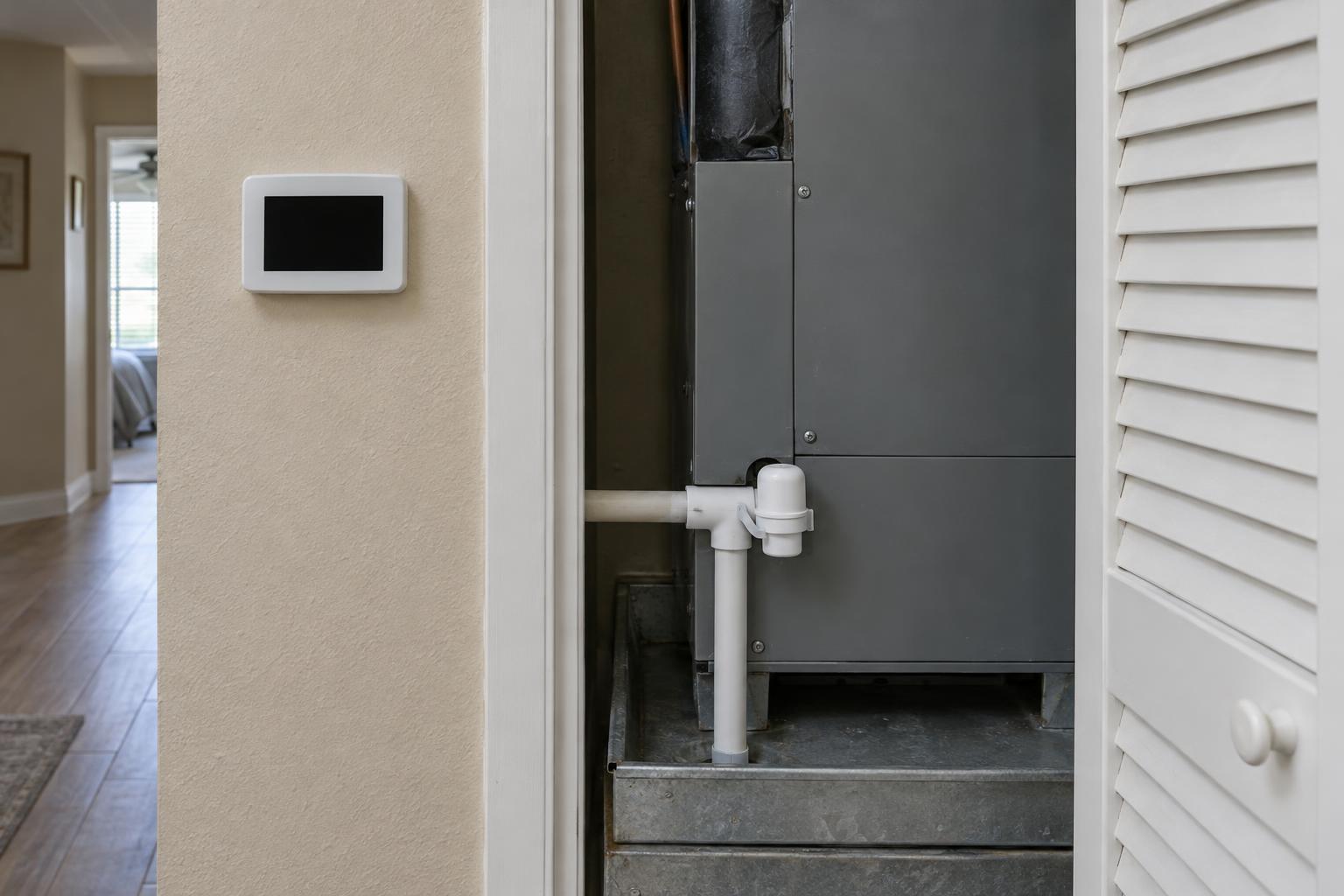
- 1. Tripped condensate float switch (most common in Florida): Algae and bio-slime thrive inside warm PVC condensate drain lines. When slow drainage raises water inside the primary drain tee or auxiliary pan, the float switch opens the 24-volt R circuit to prevent ceiling or closet water damage, instantly turning off a C-wire-powered wall display.
- 2. Depleted AA/AAA batteries or corroded contacts: Battery-powered faceplates often flash a faint low-battery icon for a few days before shutting down completely. High indoor humidity during shoulder months can also leave light green oxidation on battery springs that blocks contact.
- 3. Tripped indoor air handler circuit breaker: Remember that split systems have two separate double-pole breakers in your main electrical panel—one for the outdoor condenser and a second for the indoor air handler. Lightning transients and brief utility flickers during summer storms can trip the indoor breaker and silence the 24-volt transformer.
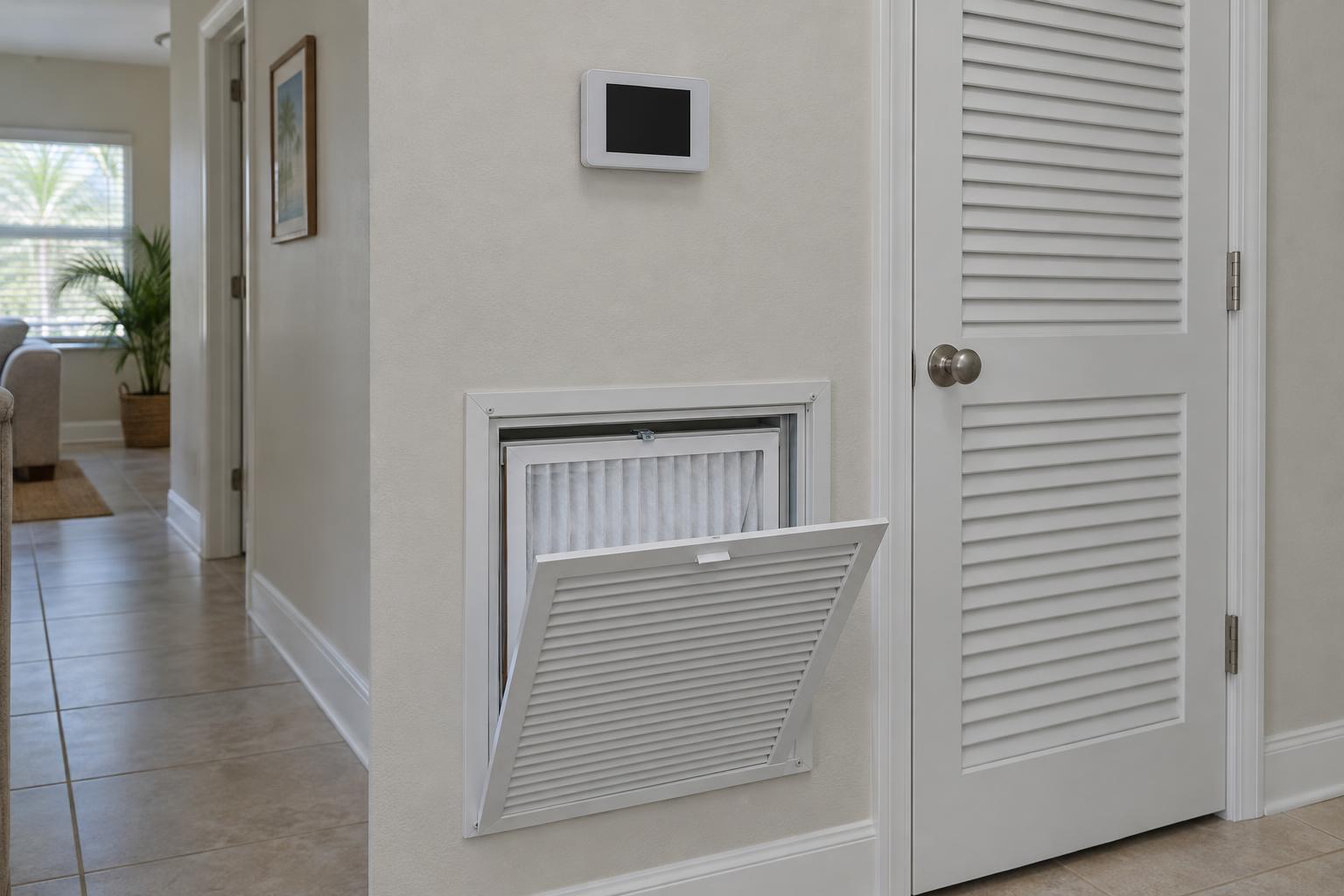
- 4. Dislodged air handler blower access panel: Many residential air handlers include an interlock safety switch behind the front service door—similar to a clothes dryer door switch. If the panel was left slightly ajar after a recent filter change, power to the control board cuts off immediately.
- 5. Blown 3-amp or 5-amp low-voltage blade fuse: Inside the air handler cabinet, a small automotive-style blade fuse protects the control board and transformer. A nicked thermostat wire behind the wall, weed-trimmer damage to the outdoor low-voltage control cable, or a shorted contactor coil outside will pop that fuse to save the board.
- 6. Failed 24-volt transformer or loose wall subbase terminal: Over years of heat cycles, transformers can burn out an internal winding, or a loose R or C conductor at the wall subbase can lose contact when drywall shifts slightly.
Safe Homeowner Checks Before Calling for HVAC Repair
You can safely inspect three items in under ten minutes without opening high-voltage electrical compartments or bypassing safety controls:
- Snap off the faceplate to inspect batteries: Gently pull the thermostat body straight off its wall subbase if your model uses removable cells. Install fresh name-brand alkaline batteries—avoiding rechargeable cells whose lower nominal voltage can leave relays weak—and check that every terminal screw holds its thin copper wire snug.
- Inspect the PVC drain float switch and pan: Look at the white PVC tee beside your indoor air handler and the shallow overflow pan underneath it. If lifting the float cap reveals standing water, or water sits in the secondary pan, the safety switch did its job by shutting the system down before water overflowed into your hallway or ceiling.
- Check the electrical panel once—never force a breaker: Open your home breaker panel and look for a handle sitting midway between ON and OFF labeled Air Handler, FAU, or Heat. Flip a tripped handle fully OFF and back ON a single time. If it trips again right away, leave it OFF so a technician can isolate the electrical fault safely.
Why Bypassing a Float Switch or Replacing a Blown Fuse Repeatedly Backfires
Homeowners searching online forums sometimes read advice suggesting they twist wires together around a wet float switch or pop a larger blade fuse onto the air handler control board. Both shortcuts create expensive secondary damage. Bypassing an open condensate safety switch lets the evaporator coil keep wringing gallons of moisture per hour out of humid Florida air with nowhere for that water to drain, soaking drywall, baseboards, or attic insulation within hours.
Likewise, a low-voltage 3-amp or 5-amp control fuse never blows from normal operation—it opens because a 24-volt wire shorted to ground or a low-voltage coil failed. Installing a higher-amp fuse feeds fault current straight into the air handler circuit board and transformer, turning a straightforward wire repair or contactor swap into a full control-board replacement. When AC repair in Palm Bay, FL is needed, a technician uses a multimeter to isolate the exact low-voltage short, clears and flushes the condensate line end-to-end, tests transformer output under load, and verifies C-wire stability before buttoning up the cabinet.
When Upgrading an Aging Thermostat Makes Sense
If your air handler delivers steady 24-volt power across R and C, the condensate drain is bone-dry, and fresh batteries still leave the display unresponsive, the thermostat’s internal power regulator has likely reached the end of its service life. Replacing a failed wall control is a practical time to verify whether an unused fifth conductor sits tucked behind the drywall to serve as a dedicated C-wire, eliminating power-stealing glitches that sometimes cause older systems to short-cycle.
Frequently Asked Questions About a Blank Thermostat Screen
Why did my thermostat go blank right when the house started getting muggy?
Peak indoor humidity causes your evaporator coil to produce maximum condensate water. If algae buildup narrows the PVC drain pipe, water backs up into the float-switch cup and cuts 24-volt power to the thermostat to stop water damage.
Can weed trimmers outside really make an indoor thermostat screen go dark?
Yes. A thin, brown two-wire or multi-wire low-voltage cable runs beside the copper refrigerant lines from your house wall to the outdoor condenser. Nicking that cable shorts the 24-volt circuit, blowing the protective blade fuse inside your indoor air handler and cutting power to the wall display.
Should both the indoor and outdoor breakers be checked if the screen is blank?
Check both breakers visually, paying special attention to the indoor air handler breaker because the indoor unit houses the 24-volt transformer that powers hardwired thermostats. Never reset any breaker more than once if it trips again.
Will replacing batteries restore cooling if the float switch tripped?
Fresh batteries may light up the screen on a battery-backed thermostat, but the air conditioner still will not turn on until the clogged condensate drain is cleared and the float switch resets the 24-volt control circuit.
Schedule Residential HVAC Troubleshooting in Brevard County
Dealing with a stubborn thermostat blank screen, a wet condensate safety switch, or an air handler breaker that will not stay set? Call Inlet Mechanical at (321) 723-0858 or schedule residential HVAC service from our headquarters at 2180 Franklin Dr NE, Palm Bay, FL 32905—serving homeowners across Palm Bay, Melbourne, Rockledge, Titusville, and Brevard County.
Talk to a Licensed Inlet Mechanical Pro
Whether it’s a repair, an upgrade, or a question, our team is ready to help homeowners and businesses across Brevard & Indian River County.
Licensed FL Mechanical (CMC1250858) · 85+ years combined experience · Free install & replacement estimates
Written & Reviewed By
Inlet Mechanical Team
The Inlet Mechanical team brings over 85 years of combined experience in HVAC, plumbing, and mechanical construction across Florida. Our licensed professionals hold Florida Mechanical HVAC License (CMC1250858) and Florida Plumbing License (CFC1433105), along with EPA Section 608 certifications. Based in Brevard County, we serve residential, commercial, and industrial clients with expert knowledge of Florida building codes, climate-specific HVAC solutions, and local plumbing requirements. Every article is reviewed by our licensed technicians to ensure accuracy and practical value for Melbourne-area homeowners and businesses.
Last Updated: November 20, 2026