
What the Supply Plenum Actually Does in Your System
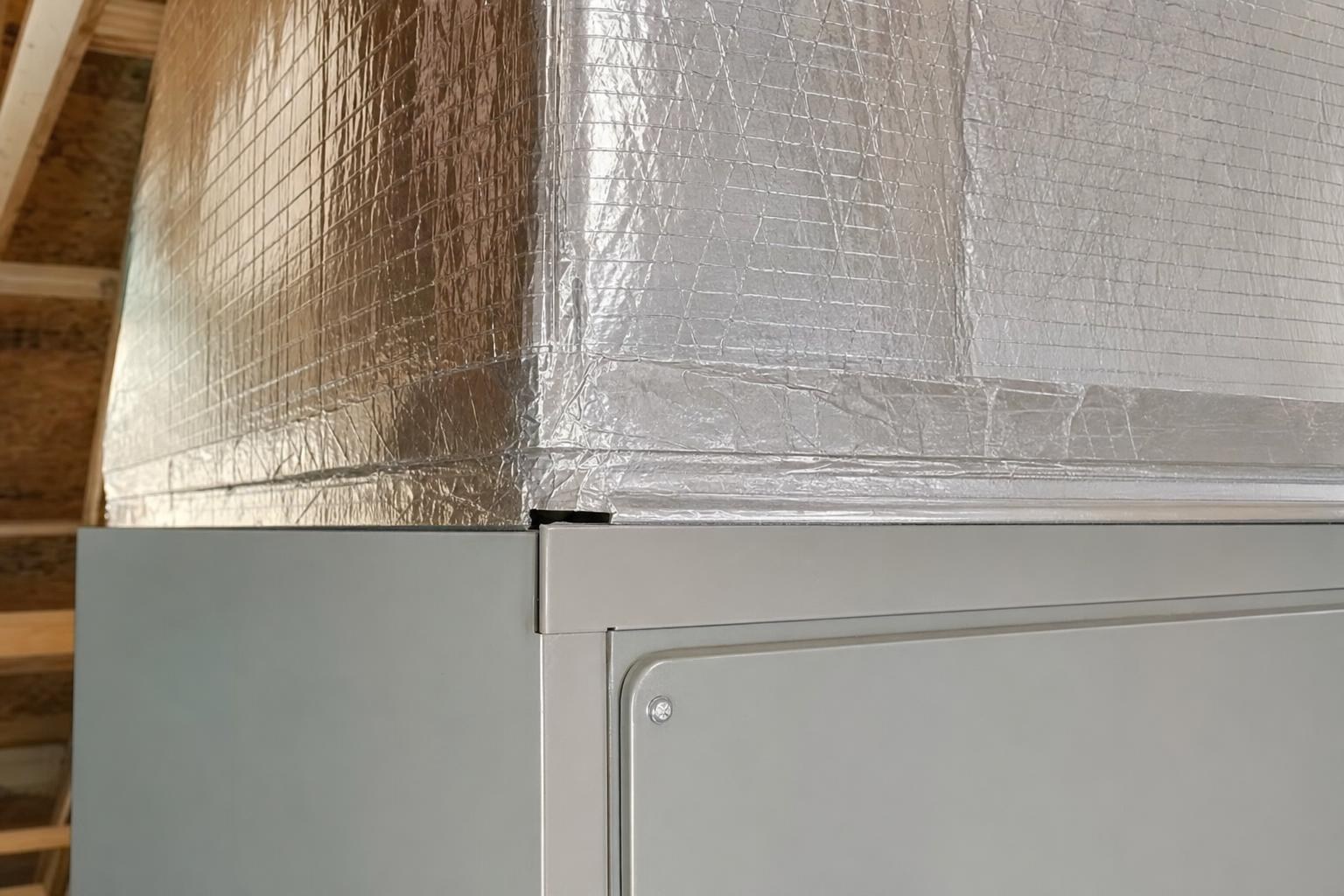
A supply plenum air leak is one of those problems that hides in plain sight — or more accurately, hides in the dark corner of a utility closet, garage, or attic where your air handler lives. Before getting into why leaks form and what they mean for a Palm Bay home, it helps to understand what the supply plenum actually is and why it sits at the center of your whole distribution system.
The supply plenum is the box-shaped chamber that attaches directly to the discharge side of your air handler. When the blower pushes conditioned air out of the unit, that air enters the plenum first. From there, it branches off into the individual supply ducts that run to each room. Think of the plenum as a distributor: the air handler is the pump, and the plenum is the manifold that feeds every downstream branch. Because 100 percent of your cooled air passes through it before going anywhere else in the house, even a modest gap or seam separation at the plenum can quietly divert a meaningful portion of that airflow into unconditioned space — an attic, a garage, or a wall cavity — rather than the rooms you are trying to cool.
In Brevard County, where cooling systems run for the better part of ten months and humidity rarely gives homeowners a break, losing conditioned air at the plenum can translate into rooms that feel stuffy, equipment that runs longer than it should, and indoor humidity that seems impossible to manage despite a system that appears to be working. The good news is that plenum leaks are a known, diagnosable, and repairable problem when approached methodically.
How Supply Plenum Air Leaks Form Over Time
Need help with AC & heating?
Inlet Mechanical’s licensed techs serve Brevard & Indian River with fast, dependable service and free estimates.
Plenums are typically fabricated from sheet metal, rigid fiberglass duct board, or a combination of both. Each material responds differently to Florida’s environment, and leaks can develop through several distinct pathways.
Sheet metal plenums rely on mechanical fasteners, sheet metal screws, and mastic sealant or foil tape at every seam and connection point. Over years of thermal cycling — the expansion and contraction that happens every time the system starts and stops — screws can work loose, tape edges can lift, and factory mastic can crack along seam lines. In coastal Brevard County, salt air accelerates corrosion on fasteners and on the metal itself, sometimes turning a hairline seam gap into a more significant opening faster than it would in an inland climate.
Duct board plenums are susceptible to a different failure mode. The fiberglass material can delaminate at corners and edges if moisture repeatedly condenses on the outer surface. Plenums located in unconditioned attic spaces are especially vulnerable because the outer surface of the box may be significantly colder than the surrounding air during peak cooling hours, creating ideal conditions for surface condensation if the insulation layer is thin, damaged, or was never applied completely.
Installation gaps are another common source. Where individual supply branches connect to the plenum, each penetration needs to be sealed at the collar. If the original installation relied only on tape rather than mastic, or if a previous service visit required disconnecting a branch without re-sealing properly afterward, that collar connection may be leaking from the day the system was put back together.
Recognizing the Signs of a Leaking Supply Plenum
Because the supply plenum is often tucked away and not visible during normal life in the home, homeowners typically notice the downstream effects before they ever suspect the plenum itself. A few patterns are worth paying attention to.
Uneven cooling across the house. If the rooms closest to the air handler feel adequately cool but rooms farther down the duct runs feel warm and humid by comparison, one possible explanation is that the plenum is not pressurizing fully. Air is escaping before it reaches the longer branch runs.
Persistent indoor humidity problems. Florida homes are naturally challenged by outdoor humidity, but a well-functioning system removes moisture as part of the cooling process. If your system is running regularly and indoor relative humidity stays uncomfortably high, reduced airflow through the living space — caused by plenum leakage into an attic or garage — can mean the air isn’t spending enough time crossing the evaporator coil to be properly dehumidified.
Dust accumulation near the air handler area. If the plenum is located in a dusty attic or a garage with particulates in the air, and that surrounding air is being drawn into the pressurized side of the system through gaps, some of that dust can be pushed into supply ducts and eventually into living spaces. Increased dust near supply registers, particularly those closest to the air handler, can be a secondary indicator.
Higher-than-expected energy bills during the cooling season. A system compensating for lost airflow tends to run longer cycles to satisfy the thermostat, which the ENERGY STAR notes as a consequence of duct leakage generally. Longer run times mean higher electricity consumption, even when outdoor temperatures haven’t changed dramatically.
None of these symptoms by themselves prove a supply plenum problem; an HVAC technician performing a proper evaluation can use pressure testing and visual inspection to locate the source.
How Technicians Approach Supply Plenum Repairs
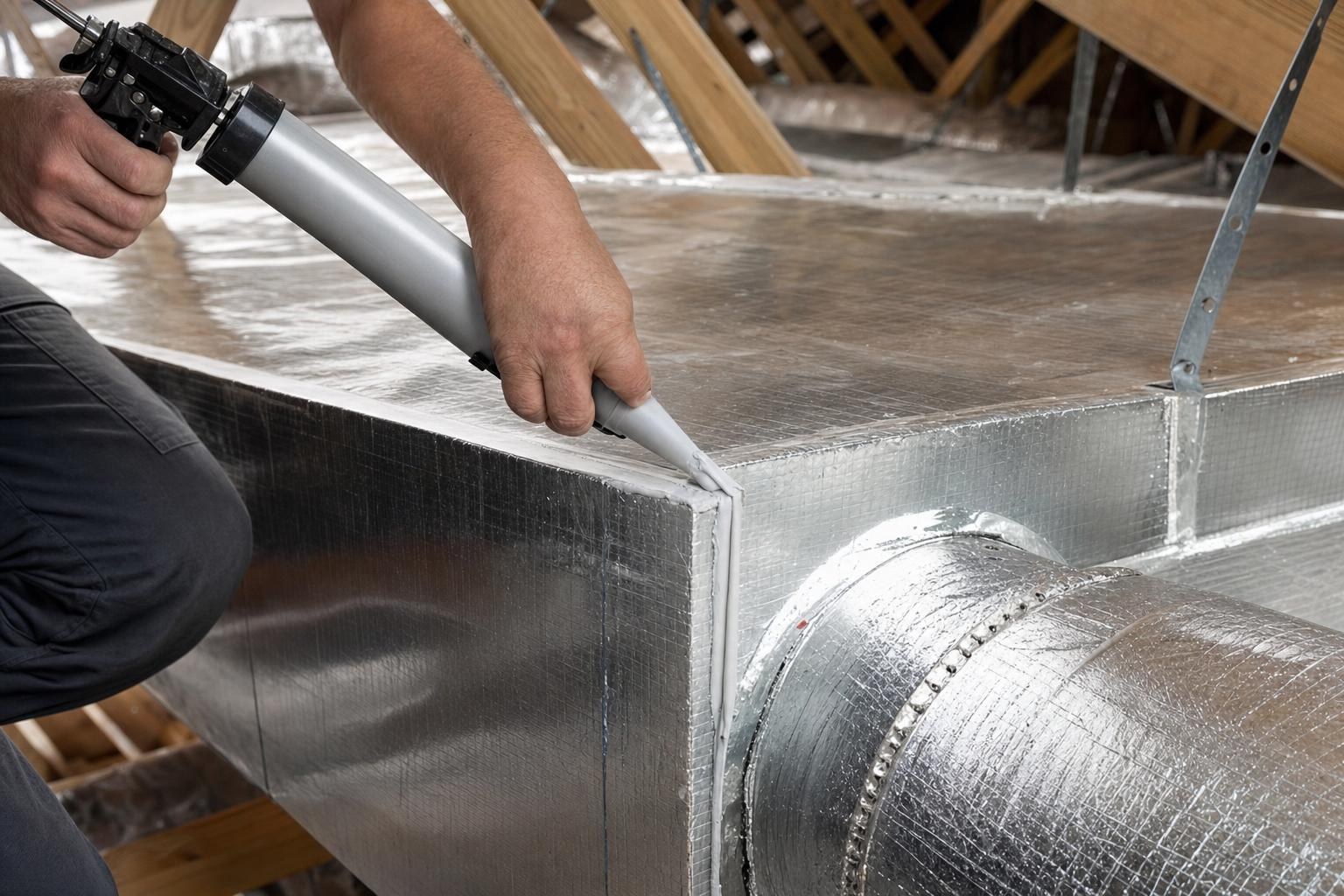
Diagnosing and repairing a supply plenum leak is a hands-on process that involves both identifying where air is escaping and then sealing those pathways durably. The approach typically follows a logical sequence.
First, a technician will visually inspect the plenum and all accessible connection points — the air handler discharge collar, each branch takeoff, and all seams along the plenum body. If insulation wrap covers portions of the plenum, it may need to be temporarily moved to assess the surface beneath.
For leaks that aren’t visually obvious, duct pressure testing can help quantify total system leakage and sometimes locate the zones where leakage is most significant. Some technicians also use theatrical smoke or other airflow visualization tools to find gaps under operating pressure.
Repairs generally use mastic sealant — a thick, flexible, brush-applied compound — as the primary sealing material. Mastic remains flexible after curing, which means it tolerates the thermal movement that causes tape-only repairs to fail over time. UL 181-listed foil tape may also be used in conjunction with mastic on certain joint configurations. Once sealing is complete, the insulation is restored or replaced if it was disturbed, and the system is tested for proper airflow to confirm the repair had the intended effect.
For plenums with more advanced corrosion, delamination, or structural deterioration, the appropriate solution may be fabricating and installing a replacement plenum rather than patching the existing one. A technician familiar with the specific conditions in Brevard County homes — attic heat loads, salt air effects on metal, and the demands of long cooling seasons — can advise on which approach makes sense for a given situation.
Keeping the Supply Plenum in Good Condition Ongoing
Repairing a leaking supply plenum is only part of the picture. Maintaining the surrounding conditions and scheduling periodic evaluations helps prevent recurrence and catches new issues before they grow.
Insulation condition matters considerably for plenums in unconditioned spaces. If the insulation wrap on the plenum or on connecting duct runs is thin, saturated with moisture, torn, or falling away, the thermal gradient that promotes condensation and accelerates material degradation is much more pronounced. During any service visit, asking the technician to note the insulation condition on the plenum and main trunk lines is a reasonable request.
Air handler maintenance also plays a supporting role. A dirty evaporator coil or a restricted filter increases the static pressure the blower is working against, which in turn increases the pressure inside the plenum. Higher plenum pressure pushes air out through gaps more aggressively. Keeping the filter clean and the coil in good condition is one practical way to reduce stress on plenum seams over time. If it’s been a while since your last service visit, exploring routine HVAC maintenance can help establish a regular baseline.
If your home has had any ductwork modifications — added supply branches, relocated registers, or system upgrades — it’s worth verifying that all new penetrations into the plenum were sealed properly at the time of the work. This is an easy step to overlook during a busy installation, and it’s the kind of detail that a follow-up inspection can catch.
Homeowners who are curious about the broader context of duct system performance can also review ductwork service options to understand how plenum condition fits into the overall picture of air distribution in a home.
Frequently Asked Questions About Supply Plenum Air Leaks
Can I seal a supply plenum leak myself with foil tape from the hardware store?
Hardware store foil tape varies significantly in quality and adhesive durability, and much of it is not rated for HVAC duct use. Even UL 181-listed tape, when used without mastic, tends to fail over years of thermal cycling because the adhesive can release from sheet metal or duct board as seams expand and contract. A DIY tape repair might reduce visible leakage temporarily, but for a durable result, mastic sealant applied by someone familiar with the access challenges and correct material choices is the more reliable approach. It’s also worth noting that the plenum and surrounding attic or utility space can present hazards — sharp metal edges, tight quarters, and significant heat in summer attics — that make this a less-than-ideal location for inexperienced work.
How does a supply plenum leak differ from a return duct leak?
Supply and return leaks have different effects on system performance. A supply plenum or supply duct leak loses already-conditioned air into unconditioned space, which is a direct energy loss — you paid to cool that air and it never reached the rooms it was intended for. A return leak, by contrast, pulls unconditioned air — hot, humid attic or garage air, for instance — into the return side of the system before it reaches the coil, which increases the load on the equipment. Both are worth addressing, but they create different symptoms and are typically found at different locations in the system.
Will a supply plenum leak cause my air handler to freeze up?
Not directly, but there is an indirect connection worth understanding. A significant supply plenum leak can reduce the volume of conditioned air circulating through the living space, which in some cases reduces the heat load on the evaporator coil. If the coil is absorbing less heat than it should because airflow is partially diverted, coil temperature can drop enough to cause frost formation. That said, coil freezing has multiple possible causes — low refrigerant, a dirty coil, a restricted filter — and a plenum leak alone is rarely the primary culprit. A technician evaluating a freeze-up will assess all contributing factors rather than attributing it to one cause without investigation.
Is the supply plenum something that gets inspected during a standard maintenance visit?
It should be, and the extent of the inspection depends somewhat on where the plenum is located and how accessible it is. A plenum in an open mechanical room is easier to examine visually than one surrounded by insulation in a tight attic. During a thorough maintenance visit, a technician can check accessible seams and connections for obvious separations, assess insulation condition, and note any corrosion or material deterioration that warrants closer attention. If you want confirmation that the plenum is specifically included in the scope of a maintenance visit, it is reasonable to ask before or during the appointment.
If you’ve noticed uneven cooling, persistent indoor humidity, or are simply curious whether your supply plenum is in good shape, the team at Inlet Mechanical is available to evaluate your system and provide a straightforward assessment. Visit our contact page to reach out, or call us directly at (321) 723-0858.
Talk to a Licensed Inlet Mechanical Pro
Whether it’s a repair, an upgrade, or a question, our team is ready to help homeowners and businesses across Brevard & Indian River County.
Licensed FL Mechanical (CMC1250858) · 85+ years combined experience · Free, no-obligation estimates
Written & Reviewed By
Inlet Mechanical Team
The Inlet Mechanical team brings over 85 years of combined experience in HVAC, plumbing, and mechanical construction across Florida. Our licensed professionals hold Florida Mechanical HVAC License (CMC1250858) and Florida Plumbing License (CFC1433105), along with EPA Section 608 certifications. Based in Brevard County, we serve residential, commercial, and industrial clients with expert knowledge of Florida building codes, climate-specific HVAC solutions, and local plumbing requirements. Every article is reviewed by our licensed technicians to ensure accuracy and practical value for Melbourne-area homeowners and businesses.
Last Updated: November 3, 2026