
A refrigerant line vibration leak is one of the quieter ways an air conditioning system can lose its charge without giving you an obvious warning sign. There is no dramatic hissing at the outdoor unit, no puddle of liquid on the floor, and often no immediate drop in cooling performance. Instead, the copper tubing that carries refrigerant between your indoor air handler and outdoor condenser slowly wears through at a single contact point, releasing refrigerant in amounts too small to notice week to week but significant enough to matter over a season or two. For homeowners in Palm Bay and across Brevard County, where the cooling system runs for nine or ten months of the year, that kind of slow attrition adds up.
This article explains exactly how vibration-induced rub-through leaks develop, where installers and technicians typically find them, what makes Florida homes especially susceptible, and what you can do to reduce the risk before a small wear point becomes an expensive repair.
How Copper Refrigerant Lines Vibrate in the First Place
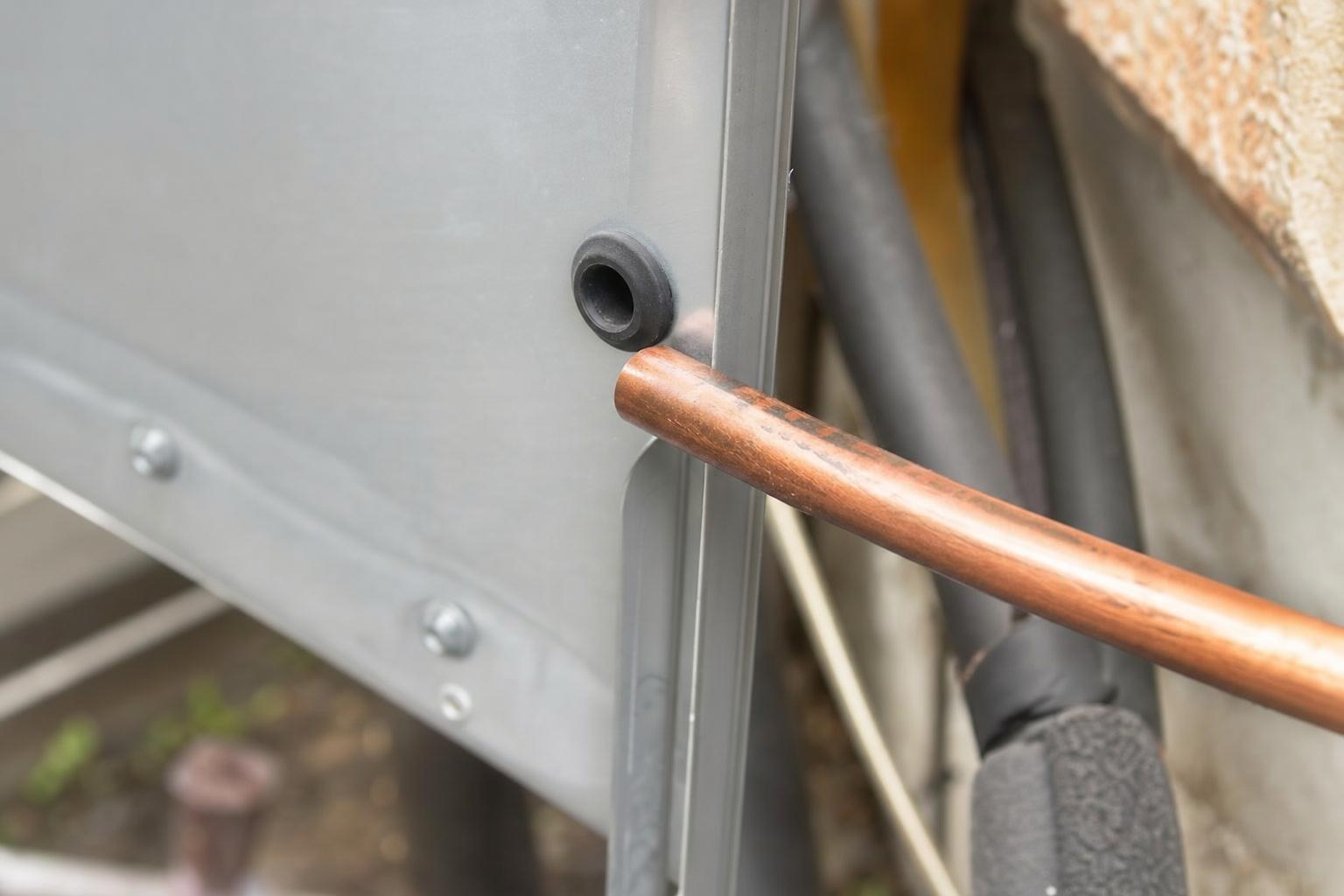
Every air conditioning compressor produces mechanical vibration as it cycles on and off and as it runs at steady state. That vibration travels through the refrigerant itself, through the copper tubing, and outward along any surface the tubing contacts. Modern variable-speed compressors modulate their output frequently, which means the tubing experiences a wide range of vibration frequencies throughout the day rather than a single predictable frequency you could design around easily.
The refrigerant lines leaving your outdoor condenser typically run through a penetration in the exterior wall, then travel inside the structure to reach the air handler. Along that path they may rest against wood framing members, pass through unlined holes in metal stud tracks, lie across concrete block ledges, or travel through attic spaces where they contact roof trusses, HVAC strapping, or adjacent ductwork. Each of those contact points is a potential wear location.
Copper is a soft metal. It resists corrosion well, bends cleanly, and conducts thermal energy efficiently, all of which make it the standard material for refrigerant lines. But those same properties mean that when a copper tube rubs repeatedly against a harder or rougher surface, the copper loses material rather than the other surface. Given enough cycles over enough time, the wall of the tube thins to the point where refrigerant pressure causes it to fail.
Refrigerant Line Vibration Leak Locations Technicians Examine Most Often
Need help with AC & heating?
Inlet Mechanical’s licensed techs serve Brevard & Indian River with fast, dependable service and free estimates.
When a technician suspects a slow refrigerant-loss pattern that does not correspond to a visible joint failure or valve problem, certain locations move to the top of the inspection list.
Wall penetrations. The hole where refrigerant lines pass from outside to inside is often cut slightly tight, or the foam used to seal it compresses over time, leaving the copper tubing in contact with the rough edge of the wood or concrete block. Each compressor start sends a small vibration pulse through the tube and into that edge.
Unlined metal stud knockouts. In homes built with metal framing or in commercial-residential mixed structures, refrigerant lines may pass through stamped metal knockouts. The cut edge of sheet metal is sharp, and even thin foam wrapping can compress and split under years of abrasion.
Attic truss and rafter contact. Florida attics are notoriously hot, which means the foam insulation wrapping around the suction line (the larger, cooler pipe) degrades faster than it might in a cooler climate. Once the insulation thins or splits, the bare copper can contact wood trusses. Compressor vibration keeps the tube moving against the wood slightly, and wood grain, knots, and fastener heads all accelerate wear.
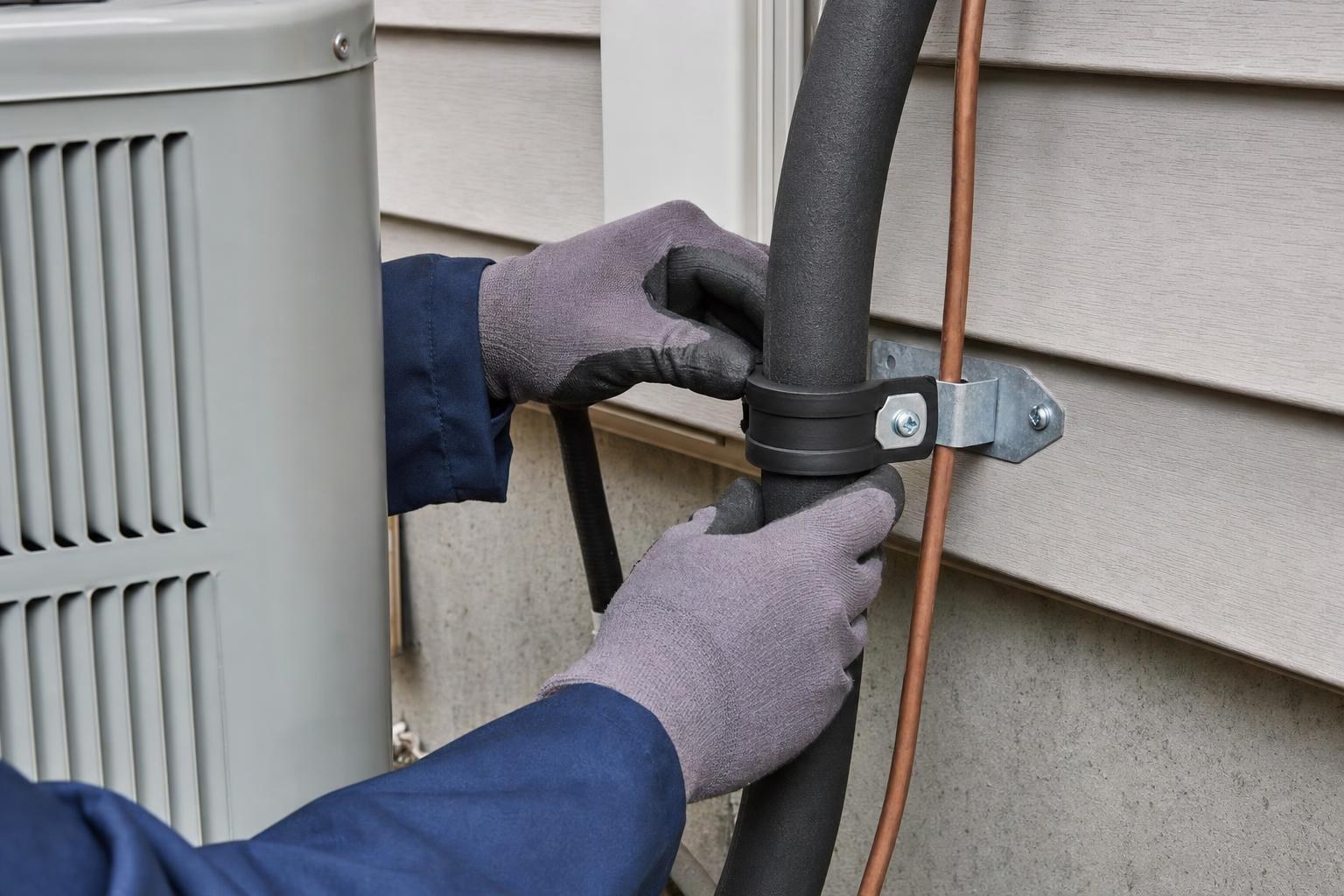
Strap and hanger edges. Refrigerant lines are secured with straps or hangers at intervals, and the edges of those fasteners can become wear points if the strap material hardens, cracks, or if the line shifts so that a metal edge rather than a padded surface bears the contact load.
Condenser cabinet entry. Inside the outdoor unit itself, vibration from the compressor and fan can cause the small copper stub-outs or connecting lines to flex repeatedly against cabinet edges, grommets that have dried out, or other internal components.
Why Florida’s Climate Accelerates the Problem
Brevard County’s long cooling season means your compressor runs far more hours per year than a system in a northern climate. More operating hours means more vibration cycles and more cumulative wear at every contact point. The math is straightforward even if the progression is invisible.
Salt air from the Atlantic and Indian River side of the county adds a secondary stress. While the copper lines themselves resist salt corrosion reasonably well, the foam insulation jackets, plastic grommets, rubber dampening materials, and neoprene straps that protect contact points do not. UV exposure and salt air degrade polymers, which means the protective layers between copper tubing and hard surfaces thin out faster than they would in inland regions.
High humidity also matters indirectly. Condensation on the suction line can pool at contact points and introduce a corrosion mechanism alongside the mechanical abrasion. Even small amounts of electrochemical activity at a wear-thinned spot can hasten the moment a pinhole forms.
Finally, Florida homes with attic air handlers experience thermal expansion and contraction as attic temperatures swing from extreme afternoon heat to cooler nighttime conditions. That daily expansion and contraction causes the tubing to move slightly at every contact point, adding a slow cyclic stress component on top of vibration-driven wear.
How Technicians Confirm a Rub-Through Leak
Diagnosing a refrigerant line vibration leak requires more than a quick glance at the outdoor unit. Because the wear point is often behind a wall, inside a wall chase, or in an attic, a thorough evaluation involves several steps.
Electronic leak detection is typically the first tool applied because it identifies the general zone where refrigerant vapor concentration is elevated. Once the zone is narrowed, a technician will physically trace the line through that zone, looking for contact points, compressed insulation, discolored copper, or the faint oily residue that refrigerant oil leaves when it escapes alongside refrigerant gas.
UV dye inspection is another approach, particularly useful when refrigerant oil has already deposited at the leak site. Dye introduced into the system during a previous service visit will show clearly under UV light at the location where refrigerant is escaping.
Once the leak site is confirmed, the technician evaluates whether the tubing wall is thin enough that a repair patch would be insufficient. In many rub-through situations, especially when the contact point is accessible, a short section of tubing is replaced and the contact condition that caused the wear is corrected. Correcting only the tube without addressing the contact point would allow the same failure to recur.
The U.S. Environmental Protection Agency guidance on refrigerant management notes that systems operating with low refrigerant charge can see significantly increased energy consumption, which is another reason slow leaks deserve attention even before comfort is visibly affected.
For homeowners who want to stay ahead of this kind of failure, annual HVAC maintenance visits that include a visual inspection of accessible refrigerant line runs and a leak detection check are the most reliable early-warning approach available.
Preventing Future Rub-Through Wear
Prevention is not complicated, but it does require that the contact conditions are actually addressed rather than simply noted. Practical steps include:
- Lining wall penetrations with snap-in grommets or foam-lined conduit sleeves so the copper never contacts raw framing material
- Re-wrapping degraded insulation jackets, particularly in attic runs, so the copper is buffered from truss and rafter surfaces
- Replacing hardened or cracked straps with fresh ones that have adequate padding at the contact surface
- Securing any loose line sections that have shifted from their original supported position over years of thermal cycling
- Adding vibration-isolating standoffs at points where the line must pass near metal edges
None of these measures require exotic materials or unusual skill. They are standard practices that a careful installation or a thorough maintenance visit should address. The challenge is that refrigerant line runs are often out of sight and out of mind until a problem surfaces through declining performance, elevated electric bills, or an insufficient cooling complaint on a hot July afternoon.
Frequently Asked Questions
Can I hear a refrigerant line vibration leak if I listen near the lines?
In most rub-through situations the answer is no, at least not until the hole is quite large. Early-stage wear produces a pinhole through which refrigerant escapes slowly. The escaping gas mixes into surrounding air quickly and does not produce the audible hiss associated with a large joint failure or a badly corroded fitting. You might notice a very faint oil smell near the leak site if refrigerant oil is present in the system, but that requires getting quite close to the specific location. Electronic leak detectors are far more reliable than listening for a sound that is often below the threshold of normal hearing in the presence of ambient noise.
Will my system stop cooling completely if it has a rub-through leak?
Not immediately, and that is part of what makes this failure mode difficult to catch early. A slow rub-through leak allows the system to lose refrigerant gradually over weeks or months. During that time the system may continue to cool adequately, especially in mild weather, while quietly losing capacity. Homeowners often first notice the problem on the hottest days of the year when the system cannot quite maintain the setpoint or when the runtime increases noticeably. By that point the refrigerant charge may have dropped enough to stress the compressor, which is the most expensive component in the system.
Is it possible to patch a rub-through spot rather than replacing a section of tubing?
Whether a patch or a section replacement is appropriate depends on the condition of the tubing wall around the wear site, the accessibility of the location, and the technician’s evaluation of how much material has been lost. At a well-defined pinhole with otherwise sound tubing, some repair approaches can be viable. However, if the wall is thinned over a broader area, or if the location is inside a wall cavity that makes patching difficult to execute cleanly, replacing a short section of tubing is often the more durable solution. In either case, the underlying contact condition that caused the wear must be corrected or the same spot will fail again within a few seasons.
How does a slow refrigerant leak affect my electricity bill?
A system running low on refrigerant has to work harder to move heat out of your home. The compressor runs longer to achieve the same cooling effect, and in some cases it may not fully achieve it at all. Longer compressor run times translate directly to higher electricity consumption. The relationship is not perfectly linear because many other variables affect system efficiency, but a meaningfully low charge will generally produce a measurable increase in operating costs before it produces a complete loss of cooling. If your electric bill has crept upward over a summer and your usage habits have not changed, it is worth having the system inspected as one of several possible explanations.
If any of the scenarios described here sound familiar, or if you would like a qualified technician to inspect your refrigerant line runs as part of a thorough system evaluation, the team at Inlet Mechanical is ready to help. You can learn more about our cooling services or reach us directly through our contact page. You are also welcome to call us at (321) 723-0858 to speak with someone about scheduling an appointment at a time that works for your household.
Talk to a Licensed Inlet Mechanical Pro
Whether it’s a repair, an upgrade, or a question, our team is ready to help homeowners and businesses across Brevard & Indian River County.
Licensed FL Mechanical (CMC1250858) · 85+ years combined experience · Free, no-obligation estimates
Written & Reviewed By
Inlet Mechanical Team
The Inlet Mechanical team brings over 85 years of combined experience in HVAC, plumbing, and mechanical construction across Florida. Our licensed professionals hold Florida Mechanical HVAC License (CMC1250858) and Florida Plumbing License (CFC1433105), along with EPA Section 608 certifications. Based in Brevard County, we serve residential, commercial, and industrial clients with expert knowledge of Florida building codes, climate-specific HVAC solutions, and local plumbing requirements. Every article is reviewed by our licensed technicians to ensure accuracy and practical value for Melbourne-area homeowners and businesses.
Last Updated: November 2, 2026