
Most of the air conditioning systems installed in Brevard County over the past decade are heat pumps, whether or not the homeowner thinks of them that way. Ten months of the year they cool, and on the handful of chilly mornings we get, they run in reverse and heat. The component that makes that reversal possible is a single brass valve mounted on the refrigerant lines inside the outdoor unit, and when it misbehaves, the symptoms confuse people. The system runs, the fan spins, the compressor hums, and the air coming out of the vents is simply wrong for the season. Understanding what the reversing valve does makes those symptoms much easier to read.
One Valve, Two Directions
A heat pump does not create heat the way a furnace does. It moves heat from one place to another using refrigerant, and the direction it moves that heat depends entirely on which way the refrigerant flows through the outdoor and indoor coils. In cooling mode, the indoor coil absorbs heat from your house and the outdoor coil dumps it into the yard. In heating mode, the roles swap: the outdoor coil pulls heat out of the outside air, even air in the fifties, and the indoor coil releases it into the house.
The reversing valve is what performs that swap. It is a four-way valve with a sliding shuttle inside, plumbed so that the compressor’s discharge can be routed to either coil. A small electromagnet called a solenoid sits on top. When the thermostat calls for the opposite mode, the solenoid energizes, a pilot mechanism uses the system’s own pressure difference to shove the shuttle across, and the refrigerant circuit flips end for end. The whole event takes a second or two and usually announces itself with a brief whoosh or swoosh sound from the outdoor unit. That sound at a mode change, or at the start of a defrost cycle, is normal. A valve that hisses constantly is not.
How Reversing Valves Fail
Need help with AC & heating?
Inlet Mechanical’s licensed techs serve Brevard & Indian River with fast, dependable service and free estimates.
Failures fall into three families, and each one produces a different pattern.
- The solenoid coil dies. The electromagnet burns out or its wiring breaks, so the valve never receives the signal to move. The system gets stuck in whichever mode the valve last held. This is the cheapest failure to fix, because the coil can be replaced without opening the refrigerant circuit.
- The shuttle sticks. Debris in the refrigerant, worn seals, or years of sitting in one position can leave the slide jammed partway or fully in one mode. A technician can sometimes free a mildly stuck valve, but a shuttle that keeps sticking is telling you the valve is worn out.
- The valve leaks internally. The seals inside wear until hot discharge gas bleeds directly into the suction side without ever visiting the coils. The system still switches modes, but capacity drops and the compressor runs hot. This one is sneaky because everything sounds normal while performance quietly erodes.
Florida adds its own wrinkle. Around here the valve may sit in the cooling position from March until December without moving once. Seals take a set, the shuttle settles in, and then the first real cold snap arrives and the thermostat asks the valve to do something it has not done in nine months. That is why so many stuck-valve calls come in during the first chilly week of the year, and it is one reason a fall check of the heating side is worth the visit even in a climate that barely needs heat.
The Symptoms Homeowners Actually Notice
Nobody calls us and says the reversing valve failed. They describe one of these situations instead.
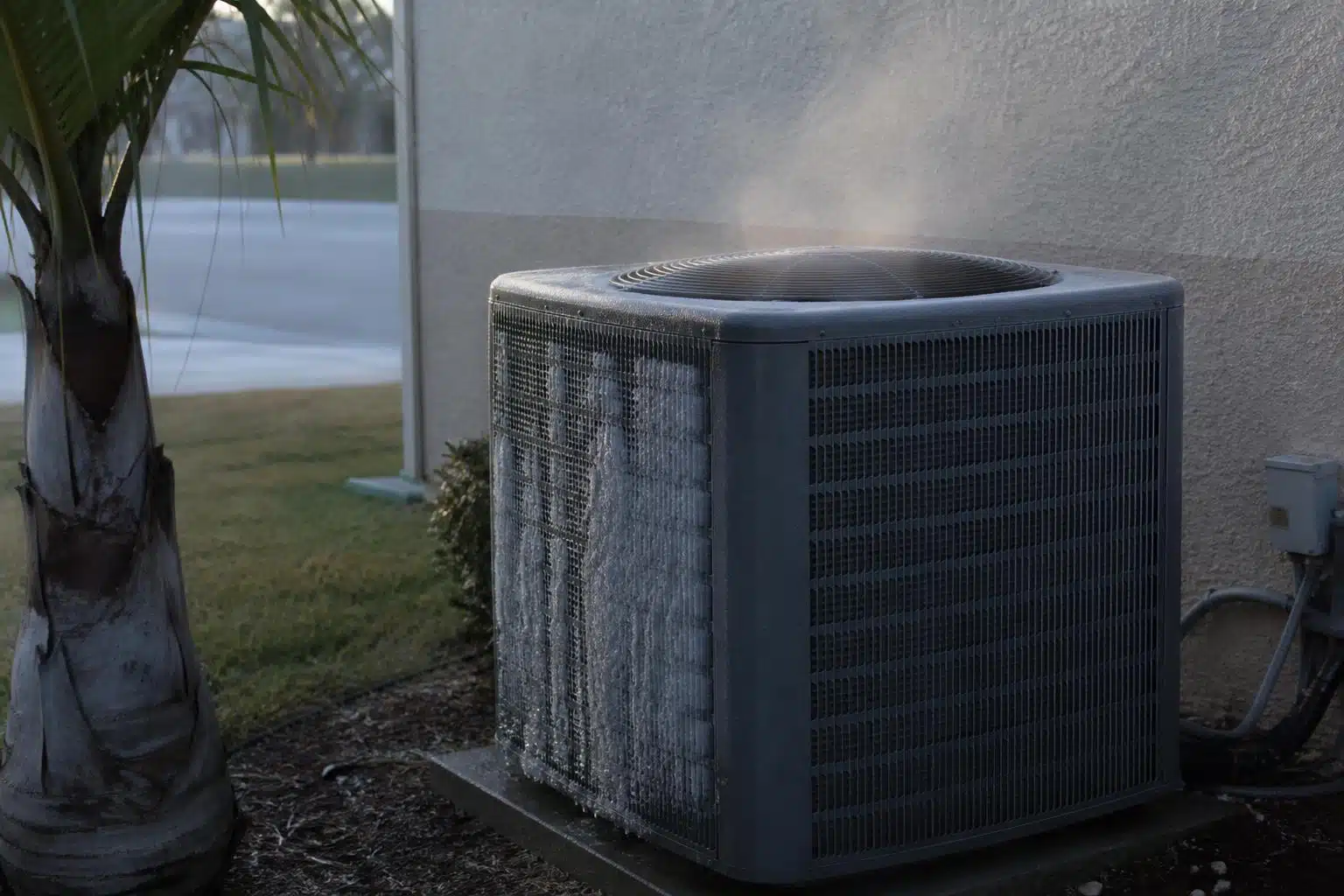
The house will not cool, but the air is not warm the way it is with a dead compressor. It is closer to room temperature, moving at full volume, accomplishing nothing. Or it is January, the thermostat is set to heat, and the vents are blowing cool air while the outdoor unit runs steadily. Some homeowners notice the electric bill instead: emergency heat strips quietly picking up the load a stuck valve dropped, at several times the operating cost of the heat pump itself.
Sound is the other clue. A short swoosh when the system changes modes or defrosts is the valve doing its job. A continuous soft hiss from the outdoor unit while it runs, paired with weak performance, points toward an internal leak. And a loud clunk or hard shudder at every mode change can mean the shuttle is slamming rather than sliding, which tends to precede a stick.
What You Can Check Before Calling
A few minutes of homeowner checks can save a service call, because two of the most common impostors live on the thermostat wall. First, confirm the thermostat mode. A thermostat switched to heat in October, sometimes by a curious kid or a guest, produces exactly the same complaint as a stuck valve. Second, if you have a newer smart thermostat, check its heat pump configuration. A thermostat wired or configured with the wrong changeover setting will energize the valve backward, so the system heats when asked to cool. This shows up constantly after do-it-yourself thermostat swaps.
Then listen. Have someone flip the mode between heat and cool while you stand at the outdoor unit. A healthy valve produces that brief whoosh within a few seconds of the call. Silence suggests the solenoid is not firing, which could be the coil, the wiring, or the thermostat signal. What you should not do is keep cycling the system back and forth hoping the valve frees itself, and there is nothing inside the refrigerant circuit a homeowner can service. Everything past the sound test is gauge-and-meter work.
Repair, Replace, or Rethink
The right fix depends entirely on which failure you have. A dead solenoid coil is a quick, inexpensive repair. A stuck or internally leaking valve is a different job: the refrigerant has to be recovered, the old valve cut and brazed out, a new one brazed in without overheating its seals, and the system evacuated and recharged. It is one of the more labor-intensive repairs on a residential system, which is why the age of the equipment belongs in the conversation.
On a five-year-old system, replacing the valve is easy to justify. On a system past the twelve-year mark, especially one running an older refrigerant, the same labor is buying time on equipment that is near the end anyway, and that money often serves you better as a down payment on heating and cooling equipment that starts the clock over. ENERGY STAR keeps a plain-language overview of modern high-efficiency heat pumps at energystar.gov, which is useful background for that conversation. An honest contractor will lay out both numbers and let the math speak. What matters most is that the diagnosis is real before anyone quotes the big repair, because a misconfigured thermostat and a failed valve can look identical from the living room.
Frequently Asked Questions
Is the whooshing sound from my heat pump normal?
A brief whoosh or swoosh at the moment the system changes between heating and cooling, or when it enters and exits a defrost cycle, is the reversing valve shifting and is completely normal. The sound that deserves attention is a constant hiss during operation, or a loud metallic clunk at every changeover. Either of those alongside weak heating or cooling is worth a diagnostic visit.
Can a stuck reversing valve fix itself?
Occasionally a mildly stuck shuttle will free up when a technician cycles the valve under controlled conditions, and sometimes a light tap while the solenoid is energized will move it. That is a reprieve rather than a repair. A valve that has stuck once has worn seals or debris inside, and it will usually stick again, often on the coldest morning of the year when you want it least.
Do reversing valves fail more in Florida?
The valve itself is no weaker here, but the usage pattern is harder on it in one specific way: it barely moves for most of the year. Sitting in the cooling position from spring through early winter lets seals take a set, so the first heating call of the season is the moment problems surface. Salt air near the coast also corrodes the solenoid coil and its wiring connections faster than inland climates do.
Why is my heat pump blowing cold air in heat mode?
The reversing valve is one suspect, but not the only one. The system may be running a normal defrost cycle, which temporarily switches to cooling for a few minutes and is no cause for alarm. Low refrigerant, a failed outdoor unit, or a thermostat configuration problem can all produce lukewarm air in heat mode. If cold air continues for more than ten minutes or so, shut the system off and have it looked at rather than letting the electric heat strips carry the house.
A heat pump that cools but will not heat, or heats but will not cool, has a story to tell, and the reversing valve is usually a main character. Inlet Mechanical diagnoses heat pumps across Palm Bay, Melbourne, and the rest of Brevard County, and we will tell you plainly whether you need a coil, a valve, or just a thermostat setting. Call us at (321) 723-0858.
Talk to a Licensed Inlet Mechanical Pro
Whether it’s a repair, an upgrade, or a question, our team is ready to help homeowners and businesses across Brevard & Indian River County.
Licensed FL Mechanical (CMC1250858) · 85+ years combined experience · Free, no-obligation estimates
Written & Reviewed By
Inlet Mechanical Team
The Inlet Mechanical team brings over 85 years of combined experience in HVAC, plumbing, and mechanical construction across Florida. Our licensed professionals hold Florida Mechanical HVAC License (CMC1250858) and Florida Plumbing License (CFC1433105), along with EPA Section 608 certifications. Based in Brevard County, we serve residential, commercial, and industrial clients with expert knowledge of Florida building codes, climate-specific HVAC solutions, and local plumbing requirements. Every article is reviewed by our licensed technicians to ensure accuracy and practical value for Melbourne-area homeowners and businesses.
Last Updated: September 15, 2026