
Flex duct sag and support spacing might not be the first thing on your mind when your air conditioner seems to be struggling, but it is one of the more common and correctable reasons a room stays warm while the rest of the house cools down just fine. Flexible ductwork is the standard in most Brevard County homes because it is lightweight, relatively inexpensive, and easy to route around attic obstructions. The problem is that it depends entirely on adequate support to hold its shape, and when that support is missing or too widely spaced, the duct develops low spots that choke airflow long before the air reaches its destination register.
How a Sagging Flex Duct Run Restricts Your Airflow
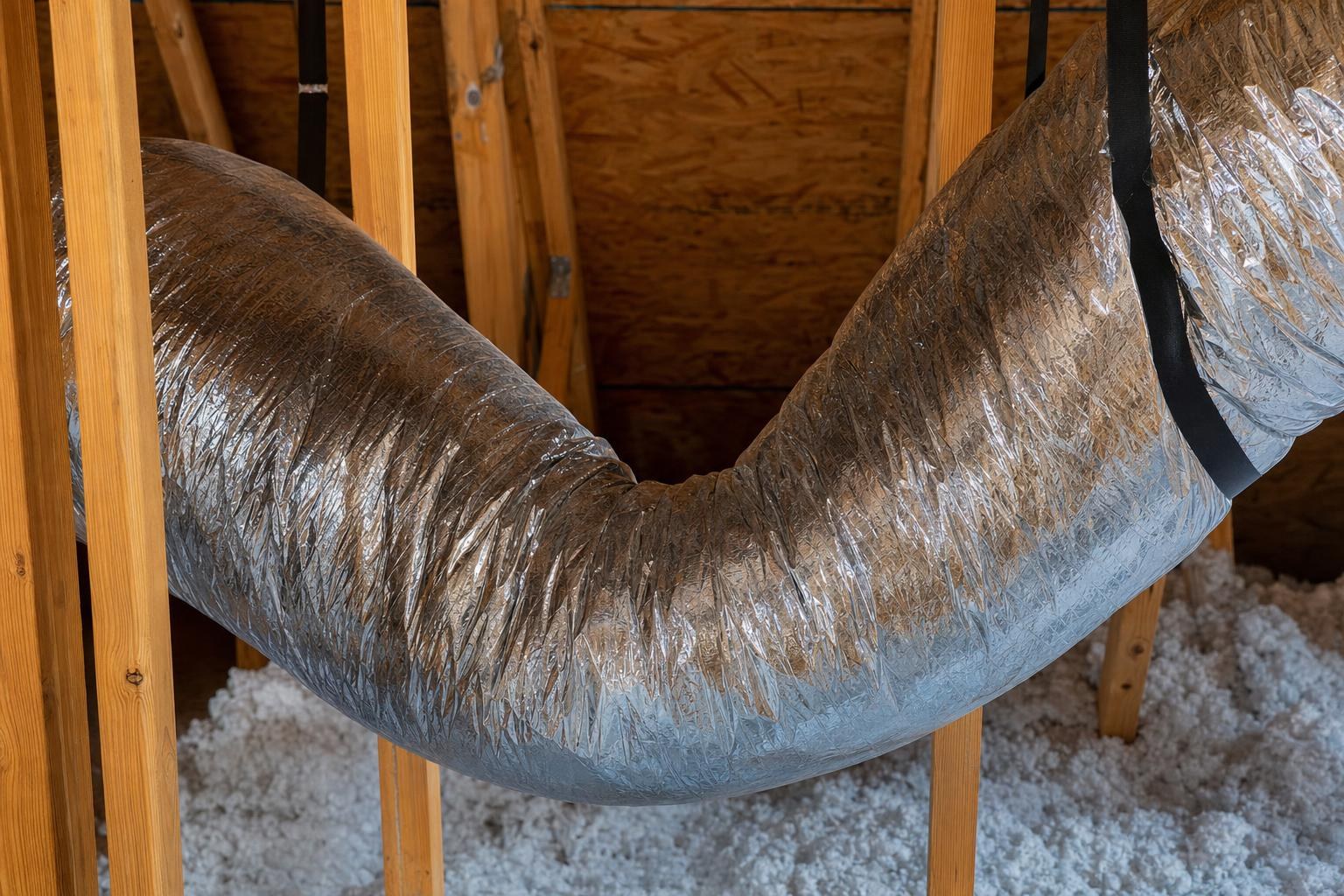
Flexible duct is made of an inner liner — usually a spiral wire core wrapped in a plastic film — surrounded by fiberglass insulation and an outer jacket. That inner liner is designed to carry conditioned air in a smooth, relatively round passage. When the duct droops between support points, the liner compresses on the underside of the sag. The round cross-section collapses into something closer to a flattened oval or kidney shape at the lowest point of the curve, and that shape dramatically reduces the area through which air can flow.
Think of it the way you might think of a kinked garden hose. The water does not stop entirely, but the flow drops noticeably. In an HVAC system, reduced airflow means the supply register in that room delivers less conditioned air than the system was designed to send. The equipment runs longer trying to satisfy the thermostat, the room stays uncomfortable, and the air handler may eventually have issues related to restricted return or supply pressure. In Florida’s long cooling season, a duct system that is working against itself is working harder every single day.
Sags can also create a secondary issue with condensation. Attic temperatures in Palm Bay and across Brevard County regularly climb well above 130 degrees Fahrenheit in summer. If the outer jacket of the duct is compromised at a sag point or if condensation collects in a low spot, moisture problems can develop inside the insulation layer over time.
What Proper Flex Duct Support Spacing Actually Looks Like
Need help with AC & heating?
Inlet Mechanical’s licensed techs serve Brevard & Indian River with fast, dependable service and free estimates.
Industry installation standards published by organizations like SMACNA (Sheet Metal and Air Conditioning Contractors’ National Association) and referenced by HVAC equipment manufacturers address support spacing for flexible duct directly. The general guidance that has been widely adopted calls for support at intervals no greater than four feet, with some specifications calling for closer spacing depending on duct diameter and routing conditions. At each support point, the duct should be held up so that the section between supports sags no more than one-half inch per foot of span. That is a relatively tight tolerance, and it is one that installers working quickly in a hot attic do not always achieve.
The supports themselves matter too. A narrow strap that cuts into the outer jacket concentrates the load on a small area and can deform the duct even at the support point itself. Properly installed straps are at least one and a half inches wide and cradle the duct rather than pinching it. Where a duct changes direction, there should be a support close to the turn to hold the bend open rather than letting the duct collapse inward on the curve.
Duct runs should also be kept as short and straight as the attic layout allows. Every unnecessary bend adds resistance to airflow, and a sharply bent flex duct that is also unsupported compounds the problem. The ENERGY STAR guidance on duct systems explains how duct design and installation quality together determine how efficiently conditioned air reaches living spaces.
Signs That Your Flex Duct Support Spacing May Need Attention
Some indications are easy to spot if you are comfortable doing a careful visual inspection of your attic. A duct that hangs noticeably between supports, one that looks flattened where it bends, or one where the outer jacket is torn or compressed against a truss is showing signs of a support issue. You may also notice that the inner liner has twisted — flex duct can spiral along its length when it is installed with too much slack and not enough support, and a twisted liner reduces airflow even when there is no obvious visible sag.
Performance symptoms inside the house are often the first thing homeowners notice. A single room or zone that consistently underperforms relative to the rest of the house, airflow that seems noticeably weaker at one register than at registers served by other ducts, or a system that runs much longer than it used to without achieving the set temperature can all point toward a duct delivery problem rather than an equipment failure. These symptoms can have multiple causes, so a thorough diagnosis is always the right starting point before any correction work begins.
Salt air is an additional factor worth mentioning along the coast. While flex duct inner liners are not metal and do not corrode the way rigid sheet metal ductwork can, the outer jacket and the wire core of the liner can degrade faster in coastal environments, and a jacket that has become brittle is more likely to split when a sagged section is disturbed.
What Duct Correction Work Involves
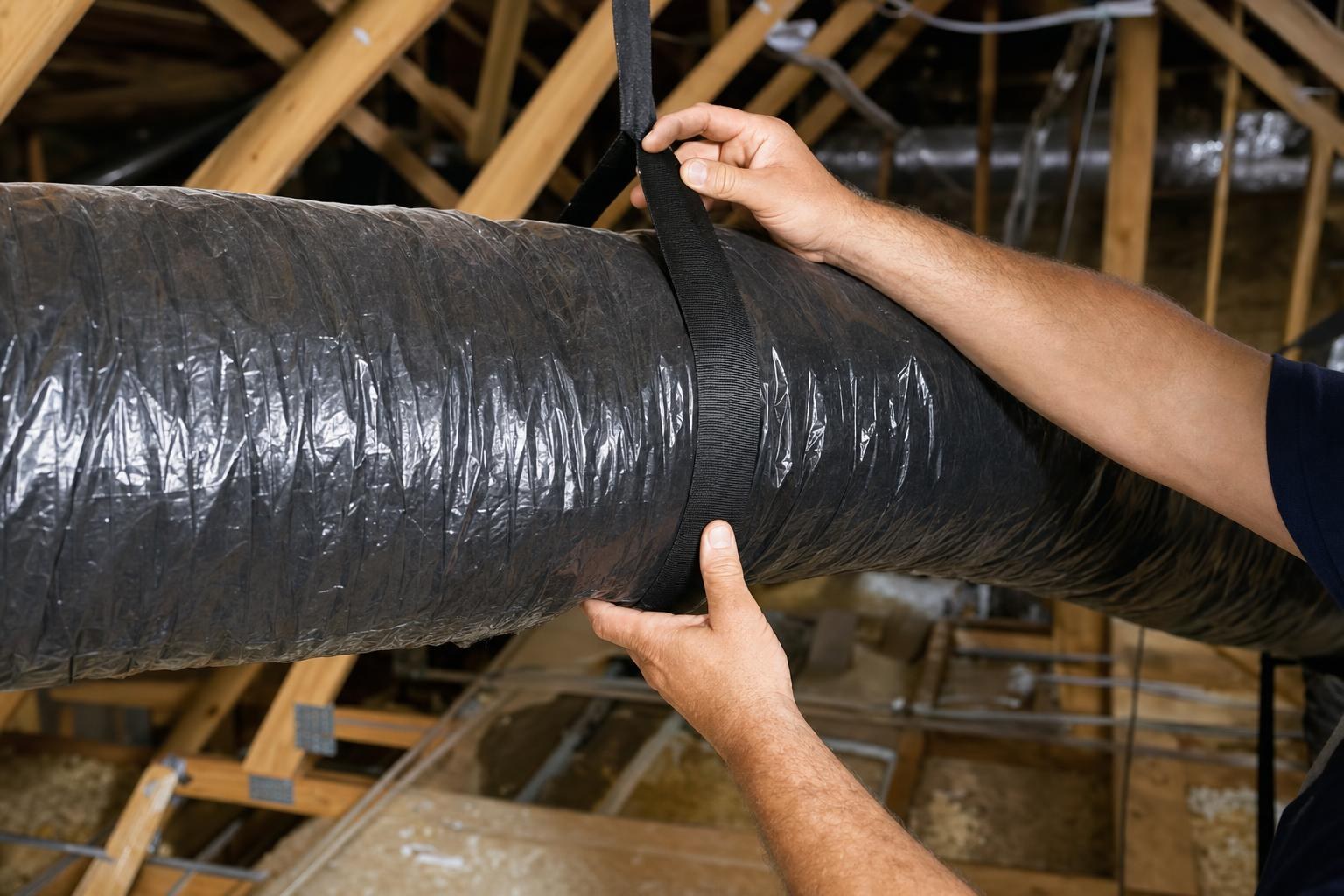
Correcting a flex duct support spacing problem generally involves accessing the attic, identifying every section of duct that is undersupported or deformed, and adding or replacing supports to bring the run back into proper shape. In some cases a section of liner that has been severely compressed or twisted is best replaced rather than simply re-supported, because a duct that has held a kinked shape for years may not fully recover its round cross-section even when the sag is lifted.
Where a run has too much slack — where the duct was cut longer than the distance it needed to span and the excess was left to bunch up — the duct may need to be re-run. Excess length creates unnecessary bends and compression points that no amount of re-strapping can fully correct. A technician will also check that connections at both ends of each run, at the plenum fitting and at the register boot, are properly secured and sealed so that lifting the duct does not open up a gap that was previously masked by the sag.
If you are considering this kind of work as part of a broader review of your duct system, our ductwork services page describes the range of assessments and corrections we perform for Brevard County homeowners.
Flex Duct Sag, Support Spacing, and Your Overall System Efficiency
A properly supported duct system is one part of a larger picture. Even when every duct run is level, round, and correctly spaced, the system still depends on adequate insulation, sealed connections, a properly sized air handler, and clean coils and filters to deliver comfortable air efficiently. Duct support corrections are most effective when they are done alongside a complete review of duct sealing and insulation, particularly in Florida attics where heat gain through an under-insulated duct adds up quickly across a cooling season that can run from April through October.
If your home has not had a duct system inspection in several years, or if it has never had one since you moved in, that inspection is a reasonable starting point. A technician who can see the actual condition of every run will be better positioned to recommend targeted corrections than one working only from symptoms reported inside the house. You can learn more about the full scope of what that kind of evaluation covers on our residential HVAC services page.
Frequently Asked Questions
How can I tell if a sagging duct is actually causing my airflow problem rather than something else?
The honest answer is that airflow complaints inside a home rarely have a single obvious cause that can be confirmed without a hands-on inspection. A room that stays warm might be explained by a sagging duct, a disconnected duct, a blocked register, an undersized duct, a leaking duct, a dirty evaporator coil, low refrigerant, or a combination of several factors. The most reliable path is to have a technician measure airflow at the registers and inspect the duct runs directly, then trace the problem back from there rather than assuming any single cause.
Is it safe for a homeowner to go into the attic and try to re-support a sagging duct themselves?
Attic access in a Brevard County home during warmer months carries genuine safety risks. Attic temperatures can exceed 130 degrees Fahrenheit on a summer afternoon, which can lead to heat exhaustion very quickly. There is also the risk of stepping through the ceiling if you miss a joist. If you choose to inspect the attic yourself, doing so early in the morning on a mild day and spending only a short time inside are reasonable precautions. Lifting and re-securing a duct that has been sagging for years can also disturb the inner liner in ways that are hard to assess without knowing what you are looking at, so professional evaluation is a sensible first step before any correction work is attempted.
Do new homes in Florida have this problem too, or is it mostly an issue in older construction?
Flex duct support issues appear in homes of all ages. In newer construction the problem is usually a result of installation practices during a busy build — straps spaced too far apart, ducts cut with excess length, or bends that were not supported close to the turn. In older homes the issue may be that original support straps have deteriorated, that the duct material itself has aged and no longer holds its shape as well, or that previous repair work disturbed supports without replacing them. Age is one factor, but installation quality at the time the ductwork was put in is often the bigger determinant.
Will correcting sag and support spacing noticeably change how my system performs?
That depends on how severe the restriction is and how many runs are affected. When a duct serving a specific problem room is badly kinked or sagging significantly, restoring its cross-section to the intended round shape can meaningfully improve airflow to that register. In cases where the sag is mild or only one of several contributing factors, the improvement may be more modest. A thorough duct inspection helps set realistic expectations, because it identifies which runs are most restricted and what other issues may also be contributing to the symptoms you are experiencing.
If you have questions about the condition of your home’s duct system or want to schedule an inspection, the team at Inlet Mechanical is ready to take a careful look. You can reach us through our contact page or by calling (321) 723-0858 to talk through what you are noticing and arrange a time that works for you.
Talk to a Licensed Inlet Mechanical Pro
Whether it’s a repair, an upgrade, or a question, our team is ready to help homeowners and businesses across Brevard & Indian River County.
Licensed FL Mechanical (CMC1250858) · 85+ years combined experience · Free, no-obligation estimates
Written & Reviewed By
Inlet Mechanical Team
The Inlet Mechanical team brings over 85 years of combined experience in HVAC, plumbing, and mechanical construction across Florida. Our licensed professionals hold Florida Mechanical HVAC License (CMC1250858) and Florida Plumbing License (CFC1433105), along with EPA Section 608 certifications. Based in Brevard County, we serve residential, commercial, and industrial clients with expert knowledge of Florida building codes, climate-specific HVAC solutions, and local plumbing requirements. Every article is reviewed by our licensed technicians to ensure accuracy and practical value for Melbourne-area homeowners and businesses.
Last Updated: October 21, 2026