
A bathroom fan that runs, sounds normal, and clears the mirror can still be doing thousands of dollars of damage over your head. In a surprising number of Brevard County houses, the duct leaving that fan never reaches the outdoors. It ends a few feet away in the attic, or it points loosely at a soffit, or it fell off its fitting years ago and nobody noticed. A bathroom exhaust fan venting attic space instead of open air is one of the most common defects we find in Melbourne homes, and it is also one of the least visible. The fan pulls moisture out of the bathroom exactly as designed, then delivers it somewhere far more expensive to repair.
Where the Duct From a Bathroom Fan Is Supposed to End
The rule is simple and there are no useful exceptions: bathroom exhaust must terminate outside the building envelope. That means a dedicated cap on the roof or a cap on a gable or exterior wall, fitted with a backdraft damper so outdoor air and insects cannot travel back inward. It does not mean the attic, the crawlspace, the garage, or a soffit cavity, and it does not mean tying into a plumbing vent or a dryer duct.
Soffit termination deserves a special note because it looks like a real solution. A cap set into the soffit sits directly beside the intake vents that feed your attic ventilation. Warm, wet exhaust leaves the cap, gets drawn straight back up into the attic through the adjacent intake, and you are right back where you started with an extra step. If a builder or a previous owner ran the duct to a soffit, treat it as a problem to correct rather than a job already done.
The other frequent finding is a duct that came apart. Housings are installed at rough-in and the ducting is sometimes attached with a single strap, so attic traffic and twenty years of heat cycles pull it loose.
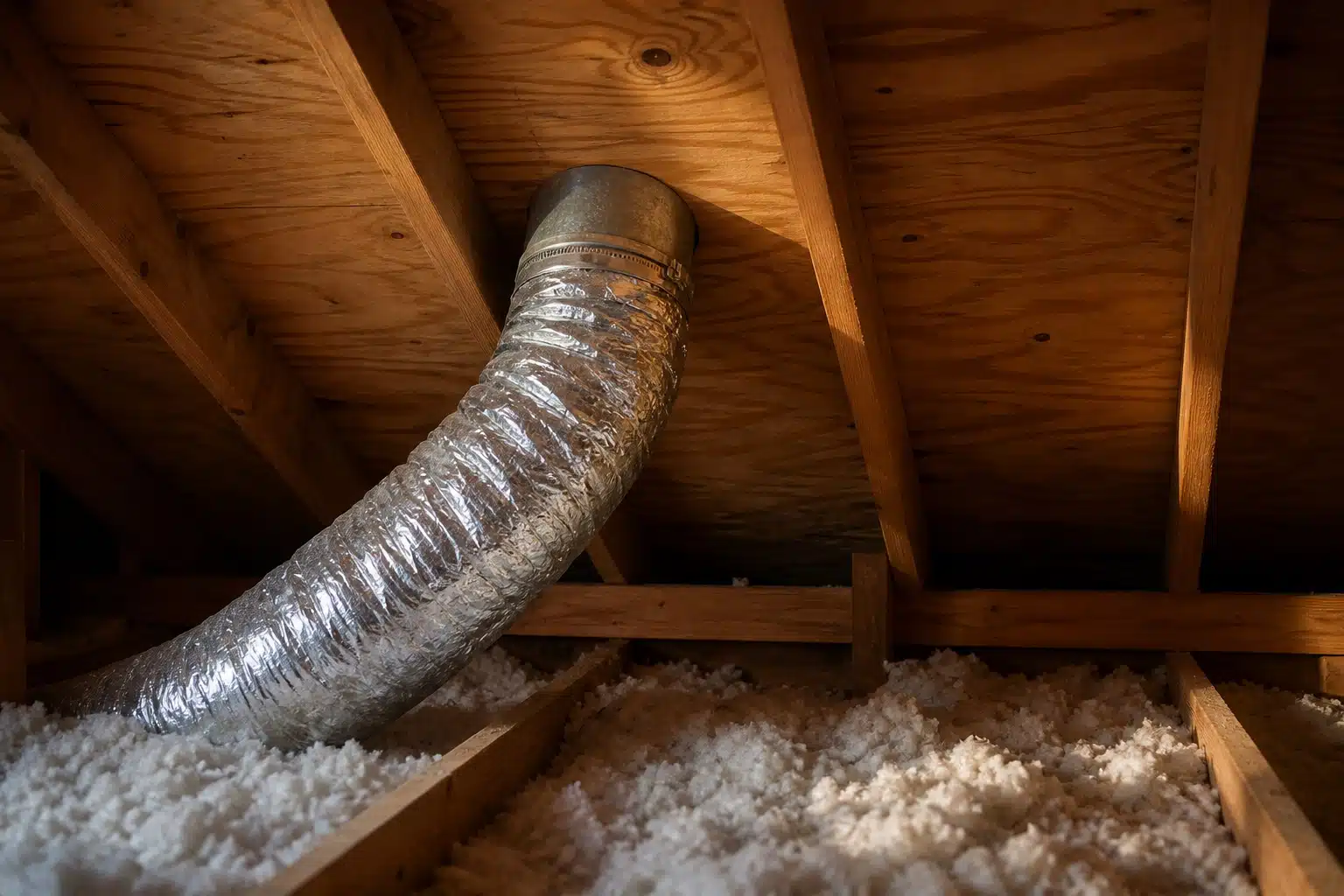
What Attic Damage From a Bathroom Fan Looks Like
Need help with AC & heating?
Inlet Mechanical’s licensed techs serve Brevard & Indian River with fast, dependable service and free estimates.
Start with the volume of water involved. A ten minute shower releases roughly half a pound to a pound of water vapor into the room, and a working fan moves most of that out through the duct. Run two or three showers a day, every day, and you are pumping several hundred pounds of water a year into a space designed to stay dry.
In the attic that vapor finds the coolest surfaces available and condenses on them. In Florida those surfaces are the metal nail plates, the duct straps, the truss connector plates, and the cold outer skin of your air conditioning ducts. The results are predictable: rust streaks on metal hardware, dark staining on the roof sheathing, blown insulation that packs down and stays damp and stops insulating, mold blooming on the underside of the roof deck, and eventually a brown ring on the bathroom ceiling as saturated insulation gives up its water. Homeowners often blame the roof for a leak that never involved rain.
Why Florida Attics Make This Worse Than Most
Northern homes with the same defect get a reprieve every winter, when cold dry outdoor air ventilates the attic and drives moisture out of the sheathing for months. Space Coast attics never get that break. Outdoor dew points here sit in the seventies from May through October, so the attic air is already close to saturated before your bathroom adds anything to it, and the drying season most building assemblies count on simply does not arrive.
Two Florida specifics make it sharper still. First, your supply ducts are up there running at 55 degrees for eight or nine months a year, which gives that added vapor a permanent cold surface to condense on. Second, homes near the Indian River and the beachside have salt in the air, and salt plus condensation accelerates corrosion on every piece of metal hardware in the attic. Add hurricane season humidity and the intermittent power loss that shuts down conditioning for days, and a fan dumping into the attic is a genuine building durability issue rather than a nuisance. This is why we treat it as part of a home’s overall ductwork services picture and not as a standalone plumbing fixture.
How to Tell Where Your Fan Actually Vents
You can answer this in about ten minutes without going into the attic. Turn each bathroom fan on, then walk outside and look for a cap on the roof or the exterior wall near that bathroom. Hold your hand at the cap and feel for a steady stream of air. If you count three bathrooms and two caps, one fan is going somewhere it should not.
From inside, hold a single square of tissue against the fan grille. If it does not hold firmly, the fan is either restricted by a long crushed duct or disconnected entirely. A ceiling that stays damp around the fan housing, a fixture that drips after a shower, or dark speckling on the ceiling paint near the fan all suggest moisture is condensing right at the housing and running back down. If you do go into the attic, look for a duct lying loose in the insulation, a duct with its end buried, or a bare uninsulated duct with beads of water on the outside.
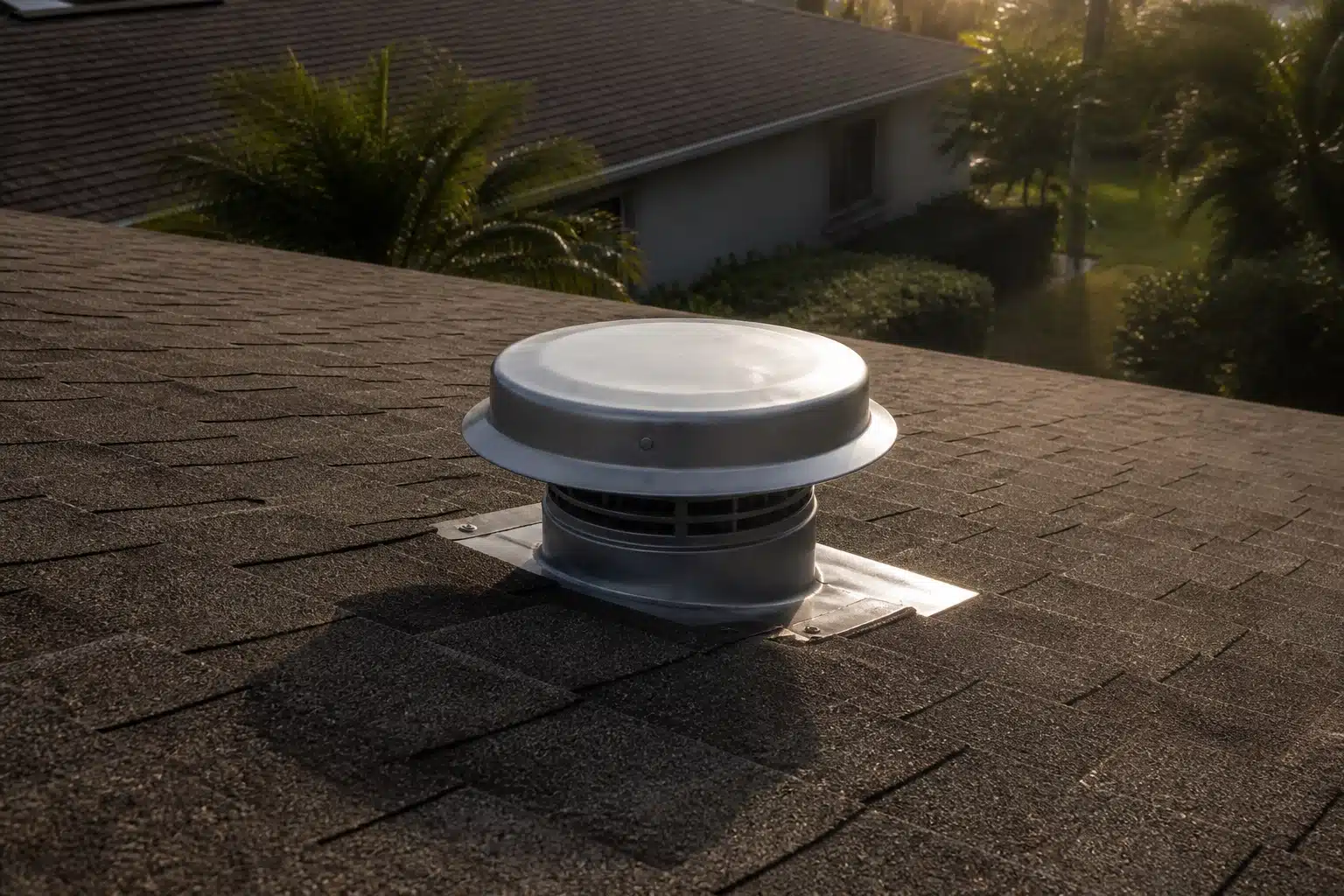
Terminating the Duct Correctly
Doing it right is not complicated, but the details matter in this climate. Use insulated duct for the attic run. Bare duct carrying warm wet air through a hot attic condenses on the inside, and that water runs back down through the fan and into the bathroom, which homeowners understandably mistake for a roof leak. Keep the run as short and as straight as the layout allows, because every elbow and every foot of flex cuts the airflow the fan can actually deliver.
Pull the duct tight rather than letting it sag, and give it a slight slope toward the exterior cap so any condensate that does form drains outward instead of pooling at a low spot. Seal the connection at the fan housing and at the cap with mastic or foil tape, not cloth duct tape, which fails in attic heat within a couple of years. Choose a cap with a functioning gravity damper, confirm the damper opens when the fan runs and closes when it stops, and never join two bathroom fans into a single duct without proper fittings and dampers, or one bathroom will exhaust into the other. The EPA’s guidance on improving indoor air quality at epa.gov treats exhausting moist air directly outdoors as a basic ventilation strategy, which is exactly what this duct exists to do.
Fan Size and Run Time Matter Too
A correctly routed duct still needs a fan capable of moving air through it. The common rule of thumb is roughly one cubic foot per minute for each square foot of bathroom floor area, with 50 CFM treated as a sensible minimum for a typical full bath and more for larger rooms or those with a separate tub and shower. Remember that a fan rated at 80 CFM on the box may deliver half that once it is connected to twenty feet of kinked flex and a restrictive cap.
Run time is the other half. Turning the fan off as you leave the bathroom removes only part of the moisture, because the air is still saturated and the walls and mirror are still wet. Twenty minutes after the shower ends is a reasonable target, which is why a simple timer switch or a humidity sensing switch is one of the better small upgrades in a Florida house. We see the difference clearly in Melbourne homes where bathrooms sit on an interior wall with no window and the fan is the only moisture path available.
Frequently Asked Questions
Is it ever acceptable to vent a bathroom fan into the attic?
No. Bathroom exhaust must terminate outside the building envelope, and a bathroom exhaust fan venting attic space is a defect regardless of how well the attic is ventilated. Attic ventilation is designed to handle the small amount of vapor that migrates up through the ceiling, not the concentrated moisture load from daily showers. In our climate the attic has no dry season to recover in, so the water accumulates rather than clearing.
Can I vent the fan through the soffit instead of the roof?
It is a poor choice in most Florida homes. A soffit cap sits right next to the intake vents that feed attic ventilation, so much of the warm wet exhaust gets drawn straight back into the attic through those intakes. A dedicated roof cap or a gable or exterior wall cap keeps the exhaust well away from any intake. If a soffit termination already exists, moving it is usually a modest job worth doing.
What does it cost to correct a fan that vents into the attic?
It depends almost entirely on the routing. If the duct simply came loose from an existing roof cap, reattaching and sealing it is a short visit. If no exterior cap exists at all, the work involves running insulated duct across the attic, cutting and flashing a new roof or wall penetration, and sealing both ends. As a rough guide for Brevard County, reattaching, insulating, and sealing a duct to a cap that already exists usually lands somewhere around 150 to 350 dollars. Cutting, flashing, and sealing a new roof or wall penetration and running new insulated duct to it is more often in the 400 to 900 dollar range, and higher if the fan itself is undersized and worth replacing while the ceiling is open. Treat those as ranges rather than quotes, because attic access, duct length, and roof type move the number more than anything else, and homes with several affected fans are usually cheaper to handle in one trip.
How do I know if attic damage has already happened?
Look at the roof sheathing directly above and around the fan for dark staining or a chalky white bloom, check the nail points and metal connector plates for rust, and press on the blown insulation near the duct to see whether it is packed down and damp. A persistent musty smell when the air handler starts is another strong signal. If any of those show up, address the moisture source first, because cleanup done before the fan is corrected will simply recur.
If you cannot find an exterior cap for every bathroom fan in your house, that is worth resolving before the next wet season. Inlet Mechanical inspects and corrects exhaust routing across Melbourne, Palm Bay, and Brevard County, and we will tell you exactly what we find above your ceiling. Call us at (321) 723-0858 or read more about our indoor air quality services.
Talk to a Licensed Inlet Mechanical Pro
Whether it’s a repair, an upgrade, or a question, our team is ready to help homeowners and businesses across Brevard & Indian River County.
Licensed FL Mechanical (CMC1250858) · 85+ years combined experience · Free, no-obligation estimates
Written & Reviewed By
Inlet Mechanical Team
The Inlet Mechanical team brings over 85 years of combined experience in HVAC, plumbing, and mechanical construction across Florida. Our licensed professionals hold Florida Mechanical HVAC License (CMC1250858) and Florida Plumbing License (CFC1433105), along with EPA Section 608 certifications. Based in Brevard County, we serve residential, commercial, and industrial clients with expert knowledge of Florida building codes, climate-specific HVAC solutions, and local plumbing requirements. Every article is reviewed by our licensed technicians to ensure accuracy and practical value for Melbourne-area homeowners and businesses.
Last Updated: July 28, 2026