
Why Space Around the Condenser Matters
Homeowners often ask us about outdoor AC unit clearance after a landscaper plants a hedge, a contractor builds a new fence, or a replacement system is squeezed into a narrow side yard. The question is a good one. The outdoor unit, called the condenser, releases the heat your air conditioner has pulled out of your house. It can only do that job well when air moves freely through it.
When something crowds the unit, the fan has to work against a restricted flow of air. Heat lingers around the coil, the system runs longer to reach the temperature you set, and the equipment is under more strain than the design intended. In a Brevard County summer, when the air conditioner runs for most of the day, that extra strain adds up. This guide explains what to look for around your condenser and what to ask before a new unit is placed.
How Your Condenser Breathes
Need help with AC & heating?
Inlet Mechanical’s licensed techs serve Brevard & Indian River with fast, dependable service. Estimates on new system installs and replacements are free.
A typical condenser pulls air in through the coil on its sides and pushes it out through a fan at the top. That means the unit needs open space on every side, and it needs open space above. Think of it as a machine that inhales along its sides and exhales upward. Block either one and the whole process slows down.
The air leaving the top is warm, and if it has nowhere to go, some of it gets pulled back into the coil. Technicians call this recirculation. The unit ends up breathing its own hot exhaust, which makes it harder for the system to shed heat. You may notice weaker cooling on the hottest afternoons, a system that runs without catching up, or a unit that shuts itself off to protect its parts.
Outdoor AC Unit Clearance: What the Manufacturer Says
There is no single distance that applies to every unit. Manufacturers publish minimum clearances in the installation manual for each model, and the numbers vary depending on the design of the unit and how it is positioned. Clearances are commonly measured in a foot or more on the sides, with considerably more room above, but your model may differ. We would rather you check the paperwork than rely on a rule of thumb you read online.
If you still have the manual, look for the section on location and clearances. If you do not, the model number on the unit’s data label will let you or a technician look it up. When you are planning a replacement, ask your installer to show you the clearance requirements for the exact model and explain how your yard measures up. A good installer will be glad to walk through it with you.
Landscaping and Plants: The Florida Growth Problem
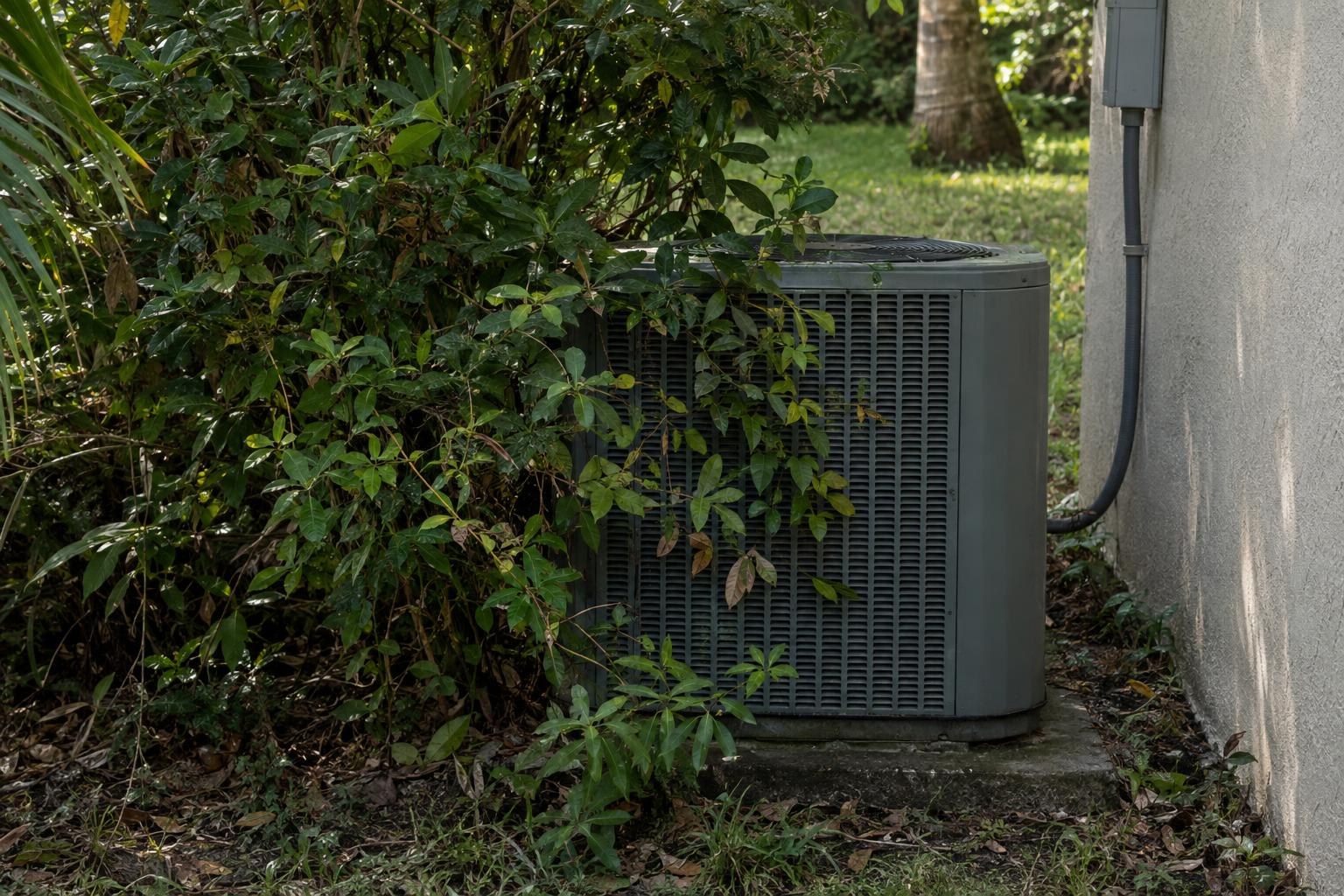
Florida plants grow fast. A neat shrub that sat comfortably three feet from the unit in spring can lean against it by the end of a wet summer. Vines climb the cabinet, grass clippings blow into the coil, and fallen leaves pile up against the grille. Mulch is another quiet culprit: when it builds up around the base of the pad, it can pile against the lower edge of the unit and hold moisture there.
A simple habit helps. Every few weeks during the growing season, walk around the condenser and look at each side. Trim back anything that has crept in, rake leaves away from the base, and keep ground cover from creeping toward the cabinet. Use hand tools and take care not to bump the fins.
Fences, Walls, and Tight Side Yards
Many Brevard County homes have narrow side yards, and that is where condensers often end up. A unit placed close to a wall or a fence has less room to draw in air, and the warm exhaust can bounce back off a solid surface. The tighter the space, the more carefully the placement needs to be planned.
Think about what sits near the unit, too. A dryer vent that discharges lint and humid air near the coil, a pool equipment pad, or a stack of stored items along the wall can all interfere. If you are adding a fence or a privacy screen, measure from the unit before you build, and leave a generous gap so a technician can still reach every side for service. Access matters as much as airflow, because a unit you cannot get to is a unit that is harder to maintain.
If your current spot is simply too tight, a replacement is a good moment to rethink it. Moving a condenser to a roomier location involves refrigerant lines and electrical connections, which are professional work. Do not attempt to relocate a unit yourself.
Keep the Top Discharge Clear
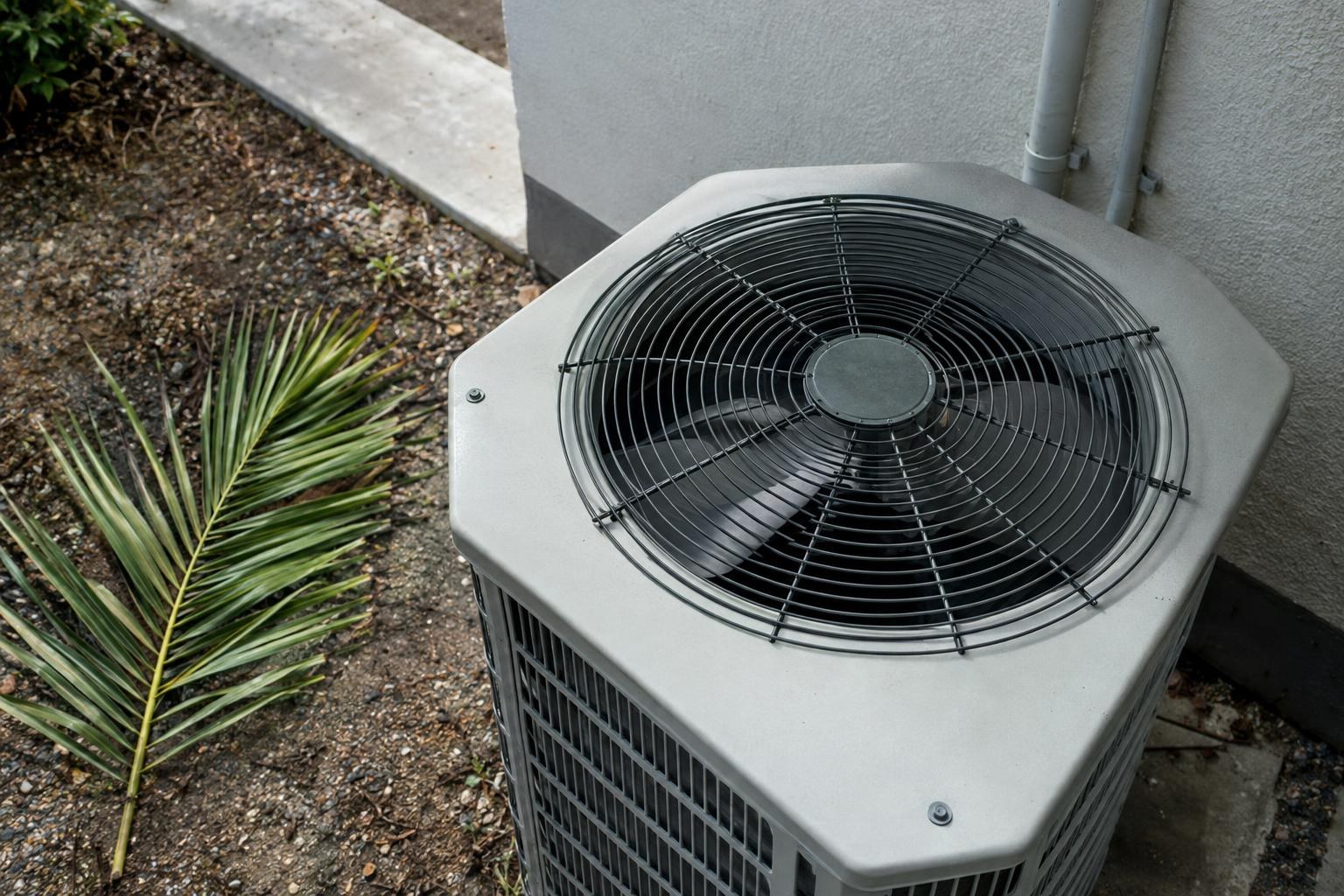
The fan grille on top is where the heated air leaves the cabinet, so the space above matters as much as the sides. Do not place anything on the unit, and do not tuck it under a low roof overhang, a deck, or a tree canopy that traps the exhaust. We also see people setting plant pots, patio items, or tools on top because it looks like a handy shelf. Please do not. Anything on the grille blocks airflow and can drop debris into the fan.
Tarps and decorative covers deserve a mention too. A cover left on while the system runs chokes off the air entirely. Even when the system is off, a tight cover can trap moisture against the coil and invite corrosion. If you want the unit to look less prominent, a properly spaced screen with open airflow is a better choice than anything wrapped around it.
New Installs and Replacements: What to Ask
When a new system is going in, the placement conversation is worth having before the pad is poured or the old one is reused. Ask your installer which clearances the manual requires, how close the unit will sit to walls, fences, and landscaping, and how you will keep it reachable for service. Ask whether the existing pad is still level and positioned well for the new model, since a replacement unit can be a different size than the one it replaces.
You can read more about the equipment side of this on our cooling services page. Regular tune-ups are also a chance to have a technician look at the space around your unit, and our maintenance services page explains what a visit includes. For general guidance on keeping a home’s heating and cooling equipment in good shape, the ENERGY STAR heating and cooling page is a useful reference.
One safety note: the condenser contains refrigerant and high-voltage electrical parts. Trimming plants and raking leaves are fine homeowner tasks, but opening panels, handling wiring, or touching refrigerant lines should be left to a professional.
Frequently Asked Questions
How much space should be around an outdoor AC unit?
It depends on the model. Clearances are commonly a foot or more on the sides with much more room above, but manufacturers set the exact distances in the installation manual. Check the manual or ask your installer to confirm the numbers for your unit.
Can I plant shrubs close to my condenser?
You can plant near it, but give the plants room to reach full size. Fast-growing Florida shrubs often outgrow their spot, so plant farther back than looks necessary and trim regularly to keep every side open.
Is it okay to cover my outdoor AC unit?
Never run the system with a cover on, because it blocks airflow completely. Tight covers can also trap moisture. If appearance is a concern, use a spaced screen that leaves air free to move around and above the unit.
Can a crowded condenser make my house hotter?
It can. Restricted airflow makes it harder for the system to release heat, so cooling may weaken and the system may run longer. If your house feels warmer than usual and the unit is crowded, clear the space first and then call for a check if the problem continues.
If your condenser is tucked into a tight spot or you are planning a replacement, our team at Inlet Mechanical is glad to look at the space and talk through the options. Visit our contact page to get started, or call us directly at (321) 723-0858.
Talk to a Licensed Inlet Mechanical Pro
Whether it’s a repair, an upgrade, or a question, our team is ready to help homeowners and businesses across Brevard & Indian River County.
Licensed FL Mechanical (CMC1250858) · 85+ years combined experience · Free install & replacement estimates
Written & Reviewed By
Inlet Mechanical Team
The Inlet Mechanical team brings over 85 years of combined experience in HVAC, plumbing, and mechanical construction across Florida. Our licensed professionals hold Florida Mechanical HVAC License (CMC1250858) and Florida Plumbing License (CFC1433105), along with EPA Section 608 certifications. Based in Brevard County, we serve residential, commercial, and industrial clients with expert knowledge of Florida building codes, climate-specific HVAC solutions, and local plumbing requirements. Every article is reviewed by our licensed technicians to ensure accuracy and practical value for Melbourne-area homeowners and businesses.
Last Updated: November 18, 2026