
Thermostat placement in a Florida home has a bigger effect on comfort and energy bills than most homeowners realize. Unlike homes in northern climates where temperature swings are seasonal and gradual, houses in Brevard County deal with outdoor heat that routinely exceeds 92°F from June through September, indoor humidity that rarely drops below 60% without active cooling, and afternoon thunderstorms that roll in almost daily during summer. When your thermostat reads the air temperature inaccurately — whether because it’s near a sunny window, above a bathroom door, or on an exterior wall — your air conditioner responds to a false signal. That means longer run cycles, uneven room temperatures, and electricity bills that climb for no good reason. Getting the location right is one of the simplest ways to improve how your system performs.
The Interior Wall Rule and Why Florida’s Climate Makes It Non-Negotiable
In many parts of the country, placing a thermostat on an exterior wall is inconvenient but not catastrophic. In Brevard County, it can add 15–20% to your cooling costs. Florida’s exterior walls absorb intense solar radiation for 10 or more hours per day in summer, and even well-insulated walls conduct that heat inward. A thermostat mounted on an east- or west-facing exterior wall may read 3–5°F warmer than the actual room air temperature, causing your system to cool past the set point and run far longer than necessary.
The correct approach is to mount the thermostat on an interior wall — one that separates two conditioned spaces, not one that faces the outside. Choose a wall in a central area of the home, roughly 5 feet above the floor, where the sensor can sample air that represents the average temperature across your living areas. Hallways that connect the main bedroom wing to the main living areas are often a practical choice, provided the hallway receives reasonable airflow from your supply registers.
One caveat specific to Florida homes: avoid interior walls that back up to a garage. Attached garages in this region frequently reach 110–120°F by mid-afternoon during summer. Even a well-insulated shared wall will be warmer than the rest of your home’s interior surfaces, and a thermostat picking up that radiant warmth will overwork your system. If your current thermostat is on that garage wall, repositioning it is a straightforward fix that can noticeably improve system behavior.
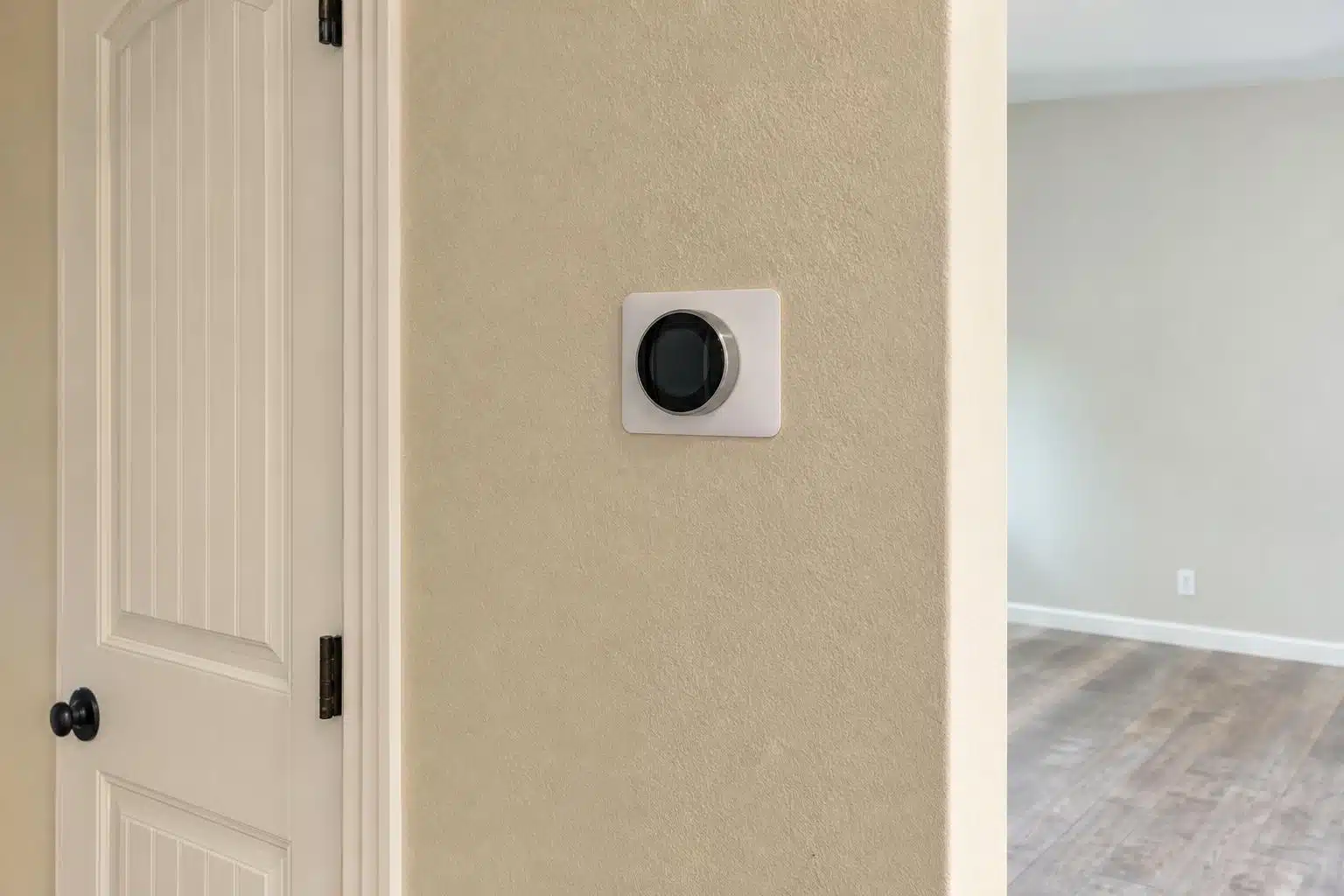
Heat Sources That Skew Thermostat Readings in Brevard Homes
Need help with AC & heating?
Inlet Mechanical’s licensed techs serve Brevard & Indian River with fast, dependable service and free estimates.
Beyond exterior walls, there are several heat sources inside a typical Brevard County home that can feed false temperature data to your thermostat. The most common offenders are lamps and recessed lighting directly above or adjacent to the unit. Incandescent and halogen bulbs emit significant radiant heat; even a single 60-watt lamp placed 18 inches from a thermostat can push the sensor reading up by 2–4°F. LED fixtures are less problematic but still worth keeping at a distance.
Sunlight streaming through a nearby window is equally disruptive. Florida’s UV index regularly hits 11 or higher in summer — the maximum on the EPA scale — and direct sunbeams warming a thermostat casing for even 30 minutes can cause your system to run continuously during mid-morning hours when the rest of the house is perfectly comfortable. South- and west-facing windows present the most risk in the afternoon hours.
Kitchen adjacency is another issue. Cooking generates substantial heat; ovens set to 375°F easily raise the surrounding air temperature by 5–10°F in an open floor plan. If the thermostat is on a wall that shares line-of-sight with the kitchen, your AC may run during dinner preparation and cycle off the moment the oven cools down, regardless of what the bedroom temperatures are doing. Locating the thermostat down a hallway or in a room separated from the kitchen by at least one doorway solves most of this interference.
Supply vents are a subtler problem. A thermostat mounted directly below or across from a supply register will sense the 55°F air blowing from the duct and shut the system off prematurely, leaving the rest of the house warmer than the set point. Keep the thermostat at least 3–4 feet from any supply register opening.
Rooms to Prioritize — and Rooms to Avoid — on the Space Coast
The ideal room for a thermostat in most Brevard County single-story homes is a central hallway or a living room that is occupied for a significant portion of the day and receives conditioned airflow from multiple registers. Occupied hours matter because thermostats with scheduling features — and modern smart thermostat installations in particular — base setback and recovery schedules on when people are typically present. Placing the thermostat in a room that reflects your household’s actual activity improves the accuracy of those learned schedules.
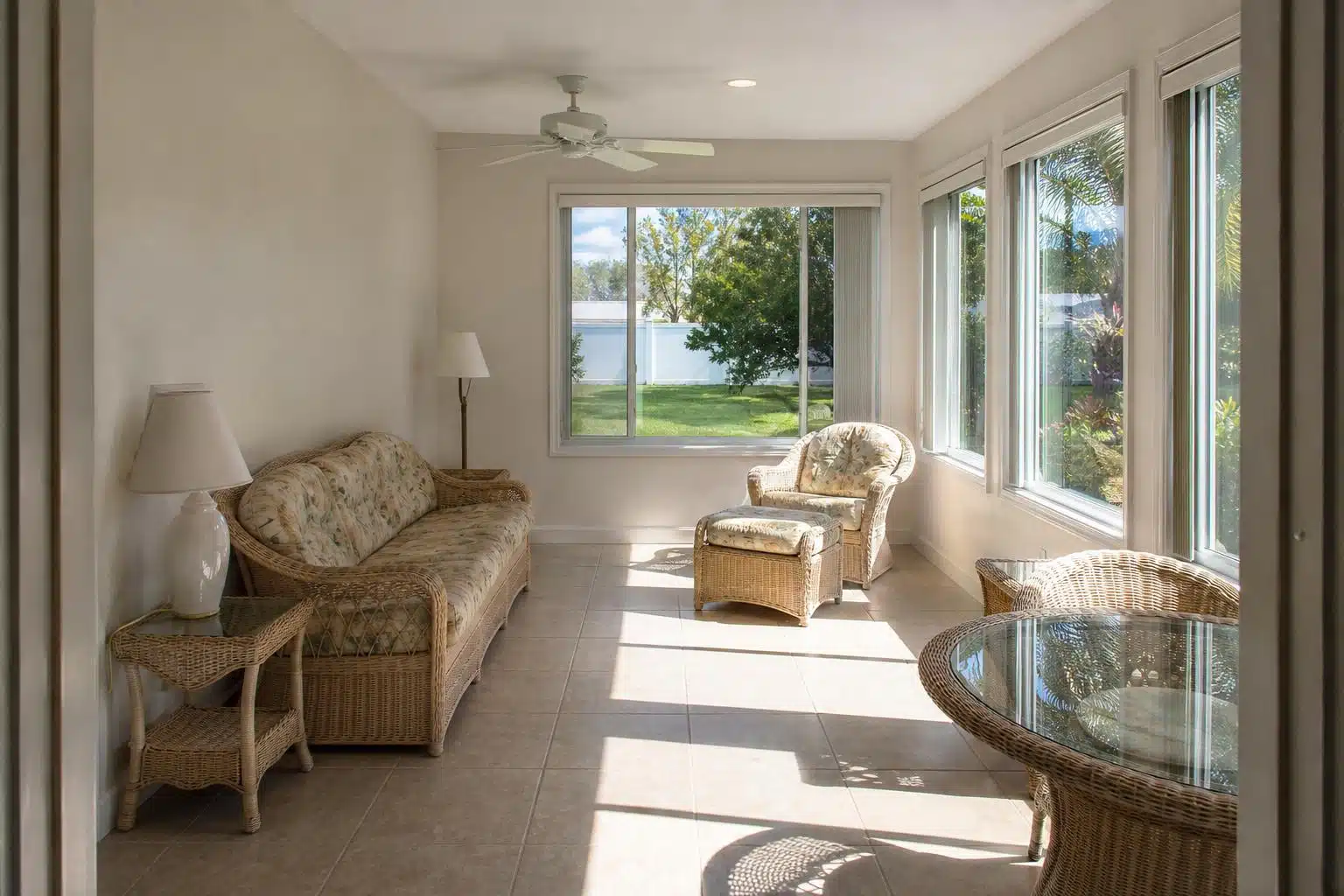
Rooms to avoid include: the master bathroom, any laundry room, and enclosed sunrooms or Florida rooms. Bathrooms generate steam and humidity spikes that confuse both temperature and humidity sensors. Laundry rooms house dryers that vent heat even when properly exhausted, and the hot water connections raise ambient temperatures. Florida rooms present a special challenge on the Space Coast — they are often semi-conditioned spaces that experience wider temperature swings than the main living area, and a thermostat there will cause your main system to react to conditions that aren’t representative of the home.
Two-story homes in areas like Viera or Rockledge face an additional consideration: heat stratification. Warm air rises, so the second floor may run 4–8°F warmer than the first floor by late afternoon. In a single-zone system, one thermostat cannot fully satisfy both floors simultaneously. If you’re consistently uncomfortable on one floor, that’s often a sign the system either needs a zone control upgrade or that the thermostat location needs to change to a floor that better reflects the zone you’re trying to control. Our team discusses HVAC efficiency upgrades that include zoning solutions worth considering for multi-story homes.
How Salt Air, Humidity, and Coastal Conditions Affect Thermostat Hardware
Homes within approximately 5 miles of the Atlantic coast — Satellite Beach, Melbourne Beach, and portions of Palm Bay near the Intracoastal — face accelerated corrosion of electronic components from salt-laden air. This affects HVAC equipment broadly, but thermostats are not immune. Standard thermostat wiring connections and circuit boards can oxidize faster than they would in an inland home, particularly if the unit is mounted near an exterior door or window that allows coastal air infiltration.
Selecting a thermostat with conformal-coated circuit boards, or at minimum inspecting connections annually, is a reasonable precaution for coastal Brevard homeowners. Energy.gov’s guidance on programmable and smart thermostats covers general selection criteria, though the coastal corrosion factor is something our team can specifically address based on your home’s proximity to the water and its ventilation habits.
Humidity is a related concern. Brevard County’s average relative humidity exceeds 70% during summer months, and spikes above 85% during and after the frequent afternoon storms that roll in from the southwest. A thermostat that includes a built-in humidity sensor — common in today’s smart models — can help your system prioritize dehumidification alongside temperature control. This is especially relevant because at 78°F and 70% relative humidity, most people feel warmer and more uncomfortable than they would at 78°F and 50% humidity. Accurate humidity readings depend on the same placement principles that govern temperature accuracy: central, interior, away from steam and direct airflow.
Practical Steps for Evaluating Your Current Thermostat Location
Before calling anyone, walk through your home and ask a few straightforward questions about your current thermostat position. First, is there a window within 3 feet that receives direct sunlight during any part of the day? Second, is the wall shared with a garage, an attic, or an exterior surface? Third, is there a supply register within 4 feet above or directly across? Fourth, is there a lamp, television, or appliance on the same wall within arm’s reach?
If you answered yes to any of these, that alone is worth investigating. A simple way to test whether your thermostat is reading accurately is to place a calibrated indoor thermometer 12 inches away from the thermostat and compare the readings over a 24-hour period. A consistent difference of 2°F or more — especially if the thermostat reads higher — suggests a placement or calibration problem.
Relocating a thermostat typically requires routing new thermostat wire through finished walls, which is more involved in a concrete block construction home — common throughout Palm Bay and Melbourne — than in a wood-frame structure. Our team handles these relocations as part of broader residential HVAC service work and can assess the cleanest wire route to the new location while confirming the move makes practical sense for your specific floor plan.
If your current thermostat is older than 10 years, a relocation project also makes sense to pair with an upgrade to a programmable or smart model. The efficiency gains from proper scheduling in Florida’s long cooling season are real — the Department of Energy estimates that setting back the thermostat by 7–10°F for 8 hours a day can reduce annual cooling costs by around 10%.
Frequently Asked Questions
Does thermostat height on the wall matter in a Florida home?
Yes, though it’s a secondary factor compared to wall selection and nearby heat sources. The standard recommendation is 5 feet above the finished floor. Mounting significantly higher than that can expose the sensor to warmer air that collects near the ceiling, while mounting lower places it closer to floor drafts. At 5 feet, the thermostat samples the air at roughly the height where occupants are seated or standing, which is the most representative measurement.
Can a smart thermostat compensate for a bad location?
Partially. Some advanced models use remote sensors placed in other rooms to average out readings, which can help offset a thermostat located in a less-than-ideal spot. However, remote sensors don’t eliminate the problem — they reduce its impact. If the main thermostat unit is receiving direct sunlight or sits on an exterior wall, the system still responds partly to that skewed reading. Correcting the placement first, then adding remote sensors, produces the best outcome.
How often should thermostat wiring be inspected in a coastal Brevard home?
For homes within 5 miles of the coastline, checking thermostat connections every 2–3 years is reasonable. Salt air accelerates oxidation on low-voltage wiring terminals, and a loose or corroded connection can cause erratic behavior — the thermostat may read incorrectly, fail to switch the system on, or cause short-cycling. An HVAC technician can clean and tighten connections during a routine maintenance visit without requiring a full thermostat replacement.
Is one thermostat enough for a two-story home in Brevard County?
A single thermostat can work in a two-story home, but it’s a compromise. The natural heat stratification in Florida — where second floors regularly run 5–8°F warmer than first floors by late afternoon — means one thermostat will always favor one floor over the other. Zoning systems with separate thermostats for each floor, or multi-zone mini-split configurations, address this more directly. If comfort is consistently uneven between floors, the underlying issue is system design rather than thermostat placement alone.
If you’re not sure whether your thermostat’s location is contributing to uneven temperatures or longer-than-expected cooling cycles, our team at Inlet Mechanical is glad to take a look. We serve homeowners throughout Brevard County, from Titusville down through Palm Bay, and evaluating thermostat placement is part of how we approach any HVAC diagnostic. Call us at (321) 723-0858, or learn more about what’s involved in a smart thermostat installation to see whether an upgrade alongside a relocation makes sense for your home.
Talk to a Licensed Inlet Mechanical Pro
Whether it’s a repair, an upgrade, or a question, our team is ready to help homeowners and businesses across Brevard & Indian River County.
Licensed FL Mechanical (CMC1250858) · 85+ years combined experience · Free, no-obligation estimates
Written & Reviewed By
Inlet Mechanical Team
The Inlet Mechanical team brings over 85 years of combined experience in HVAC, plumbing, and mechanical construction across Florida. Our licensed professionals hold Florida Mechanical HVAC License (CMC1250858) and Florida Plumbing License (CFC1433105), along with EPA Section 608 certifications. Based in Brevard County, we serve residential, commercial, and industrial clients with expert knowledge of Florida building codes, climate-specific HVAC solutions, and local plumbing requirements. Every article is reviewed by our licensed technicians to ensure accuracy and practical value for Melbourne-area homeowners and businesses.
Last Updated: August 9, 2026