
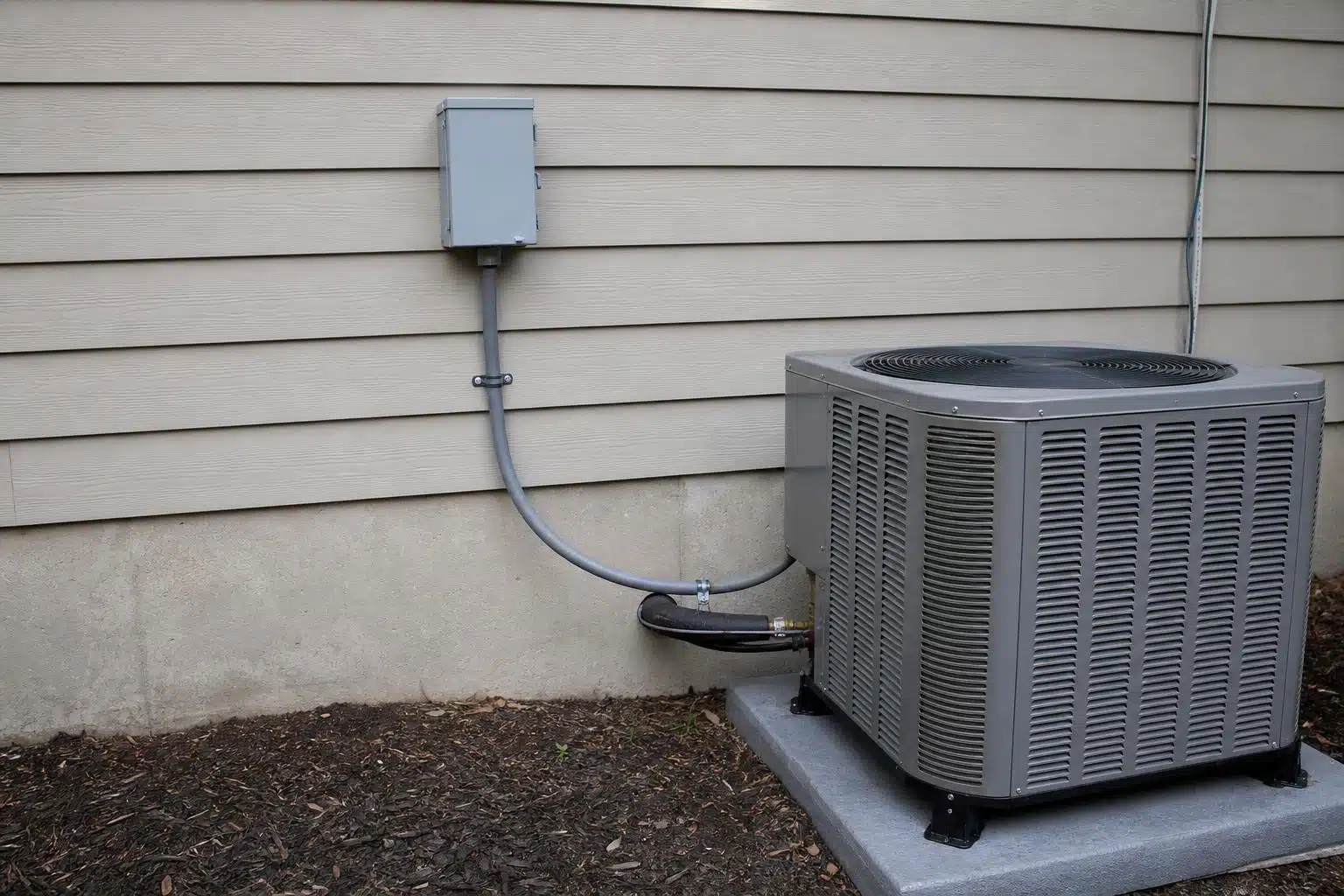
The AC disconnect box Florida homeowners see mounted on their exterior walls is easy to overlook — it sits quietly next to the condenser unit, and most people never touch it. But that small weatherproof enclosure performs a genuinely important safety function, and in Brevard County’s climate it takes a harder beating than similar equipment in drier, milder parts of the country. Between the 70%-plus summer humidity, daily afternoon thunderstorms from June through September, salt air within a few miles of the Atlantic coast, and intense UV radiation that degrades plastics and seals, outdoor electrical components here age faster and face more stress than the manufacturers’ specs often anticipate. Understanding what the disconnect does — and what its warning signs look like — helps you catch a small problem before it becomes a dangerous or expensive one.
The Basic Job of an AC Disconnect Box
In simple terms, the disconnect box is a locally accessible shutoff point for the high-voltage power feeding your outdoor condenser unit. Your home’s main electrical panel is typically in a garage or utility room, which might be 30 or 40 feet from where the condenser sits. If a technician needs to service the unit safely, they need to be able to cut power at the equipment — not walk back inside and guess which breaker is correct. The disconnect provides that local, visible shutoff.
Inside the box you’ll typically find either a pull-out fuse block or a lever-type non-fused switch, depending on the age and model of your system. Fused disconnects hold cartridge fuses rated to match your condenser’s amperage draw — usually somewhere between 30 and 60 amps for a standard residential system. When a fuse blows, it interrupts the circuit before wiring can overheat. Non-fused disconnects rely on the breaker at the panel to handle overcurrent protection and simply give the technician a mechanical shutoff point near the equipment.
The National Electrical Code requires the disconnect to be within sight of the equipment and readily accessible, which is why you’ll always see it mounted on the wall within a few feet of the condenser. This isn’t a convenience feature — it’s a code requirement designed to protect the person doing the work. If they can see both the unit and the open disconnect simultaneously, they can be confident power is actually off before they touch any wiring.
How Florida’s Climate Degrades Outdoor Electrical Hardware
Need help with AC & heating?
Inlet Mechanical’s licensed techs serve Brevard & Indian River with fast, dependable service and free estimates.
Most disconnect boxes are rated NEMA 3R, meaning they’re designed to resist rain and sleet. That’s adequate for many climates, but Brevard County adds layers of stress that NEMA 3R wasn’t necessarily imagined for. Salt-laden air from the Atlantic and Indian River Lagoon accelerates oxidation on metal contacts and the box’s interior surfaces, particularly within roughly five miles of the shoreline. Homes in Satellite Beach, Indian Harbour Beach, and Melbourne Beach see this more acutely than properties farther inland, but no part of the Space Coast is truly free from coastal air influence.
High humidity compounds the problem. When warm, moisture-heavy air contacts cooler metal surfaces inside the box — especially during the temperature swings of an afternoon thunderstorm — condensation forms. Over time, repeated moisture cycling corrodes the fuse clips or switch contacts. Corroded contacts create resistance, and resistance creates heat. That localized heat can damage insulation on the wires entering the box, char the interior plastic housing, or in worst cases cause arcing.
UV exposure is the other major factor. Direct Florida sunlight degrades the box’s outer shell, seals, and any gaskets that keep water out. A box that looks intact from ten feet away may have hairline cracks in the housing or a gasket that no longer seals properly. Once water finds its way inside, corrosion progresses much faster than it would in a box that stays dry.
Hurricane season, running June 1 through November 30, brings wind-driven rain that can force water past seals that handle normal rainfall just fine. It’s worth checking your disconnect’s condition after any significant storm passes through — not to open it yourself, but to note any visible damage or discoloration on the outside of the housing and report it to a technician.
Reading the Warning Signs Your Disconnect Needs Attention
Most homeowners won’t open the disconnect box themselves, and that’s appropriate — the voltages inside (typically 240V) are genuinely dangerous without proper training and equipment. But there are things you can observe from the outside without touching anything.
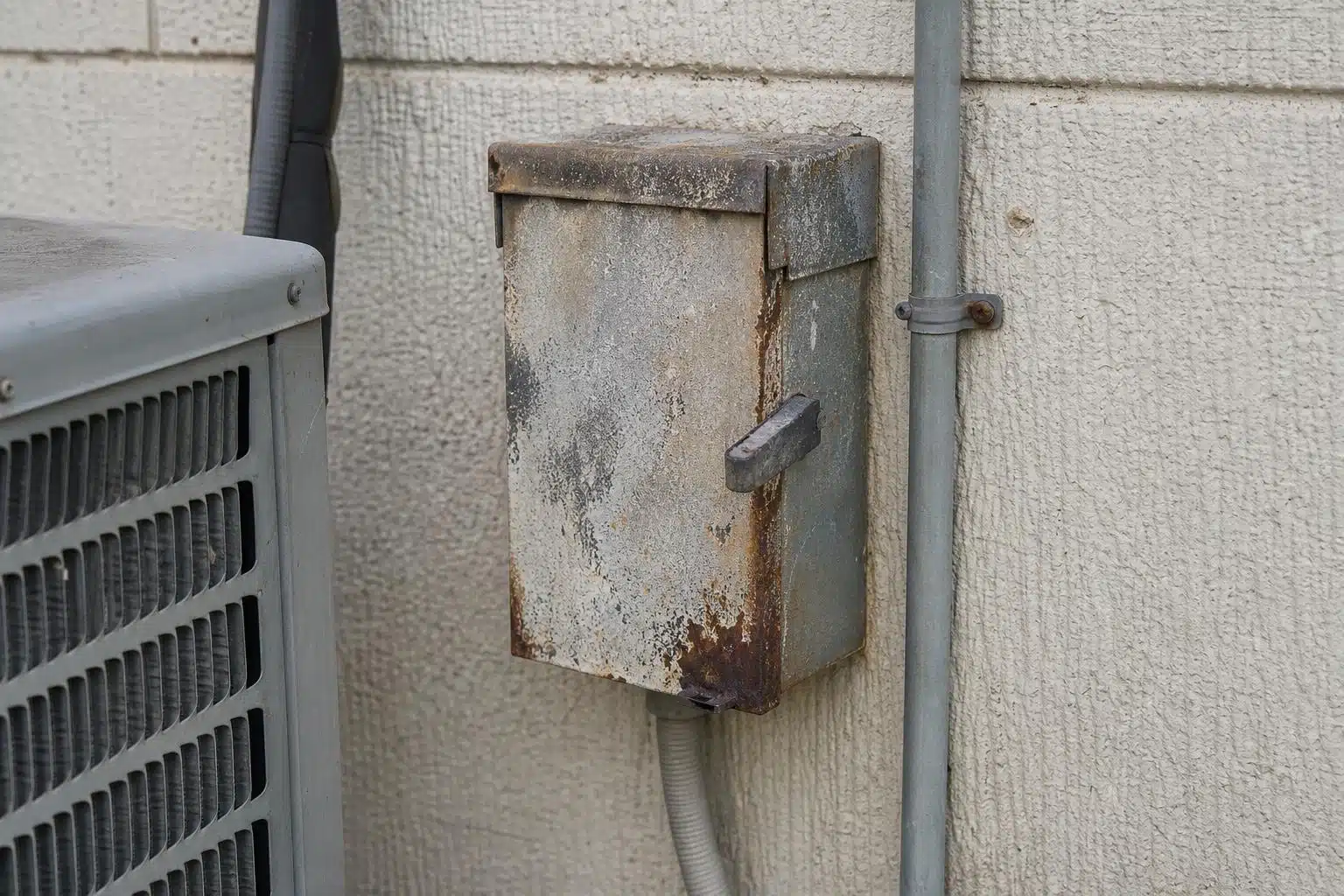
Discoloration or scorching on the exterior of the box — brown or black staining around the lid seam or conduit entry points — suggests heat has been generated inside. That’s not normal and warrants a technician visit. A burning or acrid smell near the condenser when the system is running is another serious indicator. Similarly, if your condenser unit hums but doesn’t start, one possibility is a blown fuse inside the disconnect; a technician can diagnose and replace it during a service call.
Physical damage to the box itself — cracked housing, a lid that no longer closes flush, rust streaking down the exterior wall — reduces the protection the enclosure provides and should be flagged. If the conduit entering or exiting the box shows gaps in the seal, insects and moisture have a direct path inside. Florida’s carpenter ants and mud daubers are particularly fond of nesting in electrical enclosures, and debris from nests can cause shorts.
Fuse Failures Versus Breaker Trips
If your system loses power suddenly, the cause might be a blown fuse in the disconnect or a tripped breaker at the panel — and the distinction matters for troubleshooting. A tripped breaker usually indicates an overcurrent event: the system drew more amperage than the breaker’s rating, often during a hard start on a very hot day. A blown fuse in the disconnect can mean the same thing, but it can also result from a fuse that has degraded over years of heat cycling and finally failed under normal load. Fuses that have done that tend to look discolored or physically damaged when a technician inspects them.
When the Box Itself Needs Replacement
Disconnect boxes don’t last forever. Most have a functional lifespan of 10 to 20 years, though Florida’s climate often pushes them toward the lower end of that range. If a box is original to a system that’s 15 years old, it’s a reasonable candidate for replacement during any major service or AC system replacement in Brevard County. A new box costs relatively little — typically $50 to $150 in parts — compared to the risk of an electrical fault from a compromised enclosure.
What Technicians Check During a Disconnect Inspection
During a proper AC maintenance visit or service call, a technician should open the disconnect box and visually inspect the interior. They’re looking at the condition of the fuse clips or switch contacts for oxidation or heat damage, checking that the wires are properly secured and the insulation is intact, and confirming that the amperage rating of any fuses matches the condenser’s nameplate requirements. Mismatched fuses — a common result of a well-intentioned but incorrect DIY replacement — can either fail prematurely or, worse, fail to protect the circuit they’re supposed to protect.
They’ll also confirm the box is properly sealed against moisture and that conduit connections are tight. According to Energy.gov’s guidance on air conditioning maintenance, keeping all components of your outdoor AC equipment in good condition is one of the most straightforward ways to extend system life and maintain efficiency. The disconnect is a small part of that picture, but it’s one that’s easy to neglect precisely because it doesn’t move and doesn’t make noise.
Our residential HVAC services include a review of accessible electrical components at the unit as part of routine maintenance, which means we’re not waiting for a failure to catch deterioration.
Disconnect Box Maintenance Habits for Brevard Homeowners
You don’t need to be an electrician to take a few sensible precautions. Trim back any vegetation that grows close to the condenser and disconnect — overgrown shrubs trap moisture against the box and block airflow around the unit. Clear away debris after storms. Keep a three-foot clearance around the condenser as a general rule; that open space also makes it easier to notice any physical changes to the disconnect housing.
If you’re having any electrical work done in your home, ask your contractor to note the condition of the outdoor disconnect while they’re in the area. And if you haven’t had a professional AC tune-up in the past 12 months, scheduling one before the peak of summer is the most reliable way to catch developing electrical issues before temperatures push your system to run eight or more hours a day. In Palm Bay and Melbourne, we regularly see systems that run nearly continuously from late May through September — that’s sustained electrical load on every component, including the disconnect.
Homeowners in Melbourne and surrounding communities who have older systems or who are closer to the coast should think of the disconnect inspection as a non-optional part of annual maintenance, not an optional add-on.
Frequently Asked Questions
Can I open my AC disconnect box myself to check the fuses?
The box contains 240-volt wiring that can cause serious injury or death without the right training and personal protective equipment. While some homeowners do pull the fuse block with the power off at the breaker, we’d recommend leaving interior inspection to a licensed technician. If your system has stopped working and you suspect a blown fuse, a service call is the safest path to a proper diagnosis, since a blown fuse is often a symptom of an underlying issue rather than the root cause.
How often should the disconnect box be inspected in Florida’s climate?
Once a year is a reasonable baseline, and your annual AC maintenance visit is the natural time for it. If your home is within a mile or two of the coast, or if your system is more than ten years old, more frequent attention makes sense. After a significant hurricane or tropical storm, a visual check of the box’s exterior condition is worthwhile before the next cooling season begins.
Does replacing my condenser unit mean I also need a new disconnect box?
Not always, but the amperage rating of the new condenser may differ from the old one, requiring a different fuse size or a box with a higher rating. If the existing box is in poor condition, replacing it at the same time as the condenser is efficient and cost-effective, since the labor is already allocated. We evaluate the existing disconnect as part of any condenser replacement we perform and recommend replacement when the hardware warrants it.
What’s the difference between the disconnect box and the breaker in my electrical panel?
The panel breaker protects the entire circuit from your home’s electrical system to the condenser and provides overcurrent protection for the wiring inside your walls. The disconnect box provides a local, visible shutoff right at the equipment — required by code so a technician can confirm power is cut before working on the unit. The two work together; neither replaces the function of the other. Fused disconnects add a second layer of overcurrent protection specifically at the condenser.
If you have questions about your outdoor electrical components or want to schedule a maintenance visit that includes a disconnect inspection, our team at Inlet Mechanical is straightforward to reach at (321) 723-0858. We serve homes across Brevard County, and you can find more detail about the full range of work we do on our residential cooling services page.
Talk to a Licensed Inlet Mechanical Pro
Whether it’s a repair, an upgrade, or a question, our team is ready to help homeowners and businesses across Brevard & Indian River County.
Licensed FL Mechanical (CMC1250858) · 85+ years combined experience · Free, no-obligation estimates
Written & Reviewed By
Inlet Mechanical Team
The Inlet Mechanical team brings over 85 years of combined experience in HVAC, plumbing, and mechanical construction across Florida. Our licensed professionals hold Florida Mechanical HVAC License (CMC1250858) and Florida Plumbing License (CFC1433105), along with EPA Section 608 certifications. Based in Brevard County, we serve residential, commercial, and industrial clients with expert knowledge of Florida building codes, climate-specific HVAC solutions, and local plumbing requirements. Every article is reviewed by our licensed technicians to ensure accuracy and practical value for Melbourne-area homeowners and businesses.
Last Updated: August 26, 2026