
Orange staining in the tub and a rotten egg odor at the tap are the two complaints that bring most private well owners to the phone, and in Brevard County the usual culprits are iron and sulfur in the well water. They are also two genuinely different problems that happen to arrive together often enough that people treat them as one. That confusion is expensive, because the equipment that handles dissolved iron does nothing for hydrogen sulfide, and a softener installed to fix a smell will be replaced within a few years having solved nothing. Getting the diagnosis right first is what makes the treatment work.
Where the Iron and Sulfur Come From
Brevard County wells draw from the shallow surficial aquifer or from the deeper Floridan aquifer, and the water in each picks up whatever it passes through. Iron leaches from soils, sand, and rock, and it dissolves readily in groundwater that has little contact with oxygen. That is why so much well water looks perfectly clear at the tap and only turns orange after it has sat in a glass or a toilet tank for a while. The iron was there the whole time, dissolved and invisible, until air got to it.
Sulfur is a different story. The rotten egg odor is hydrogen sulfide gas, and in most wells it is produced biologically. Sulfate-reducing bacteria living in oxygen-poor groundwater metabolize naturally occurring sulfate and release hydrogen sulfide as a byproduct. Decaying organic matter in the surrounding formation can contribute as well. There is one important exception worth checking before you spend a dollar on well treatment: if the smell appears only on the hot side, the source is very often a reaction between the magnesium anode rod in the water heater and sulfate in the water, not the well at all. That distinction takes five minutes to test and can turn a whole-house treatment project into a simple water heater service call.
What Well Water Testing in Brevard County Reveals
Need help with plumbing?
Inlet Mechanical’s licensed techs serve Brevard & Indian River with fast, dependable service and free estimates.
Guessing from symptoms gets you partway. A proper test gets you the rest, and the parameter list matters. A useful panel includes total iron and dissolved ferrous iron reported separately, manganese, hydrogen sulfide, pH, hardness, total dissolved solids, tannins, and a bacteriological screen for total coliform and E. coli. Iron bacteria are worth checking for specifically, because they change the treatment approach entirely.
Two details trip people up. First, pH drives everything downstream. Oxidation-based treatment, which is the standard approach for both iron and sulfide, works poorly when pH drops much below seven, and low pH is common in surficial aquifer water here. If the pH is low, correcting it comes first or the filter that follows never performs. Second, hydrogen sulfide off-gasses from a sample almost immediately, so a bottle collected in the morning and tested at home in the afternoon reads far lower than the well actually contains. Sulfide needs to be measured on site or in a properly preserved sample sent to a state-certified lab. The Environmental Protection Agency private well resources lay out sensible testing practice, including annual bacteriological testing, which private wells do not get automatically the way a public system does. For reference, iron begins staining fixtures around three tenths of a milligram per liter, and most people can smell hydrogen sulfide well below half a milligram per liter, so the thresholds that cause complaints are low.
Why the Stains and the Smell Are Different Problems
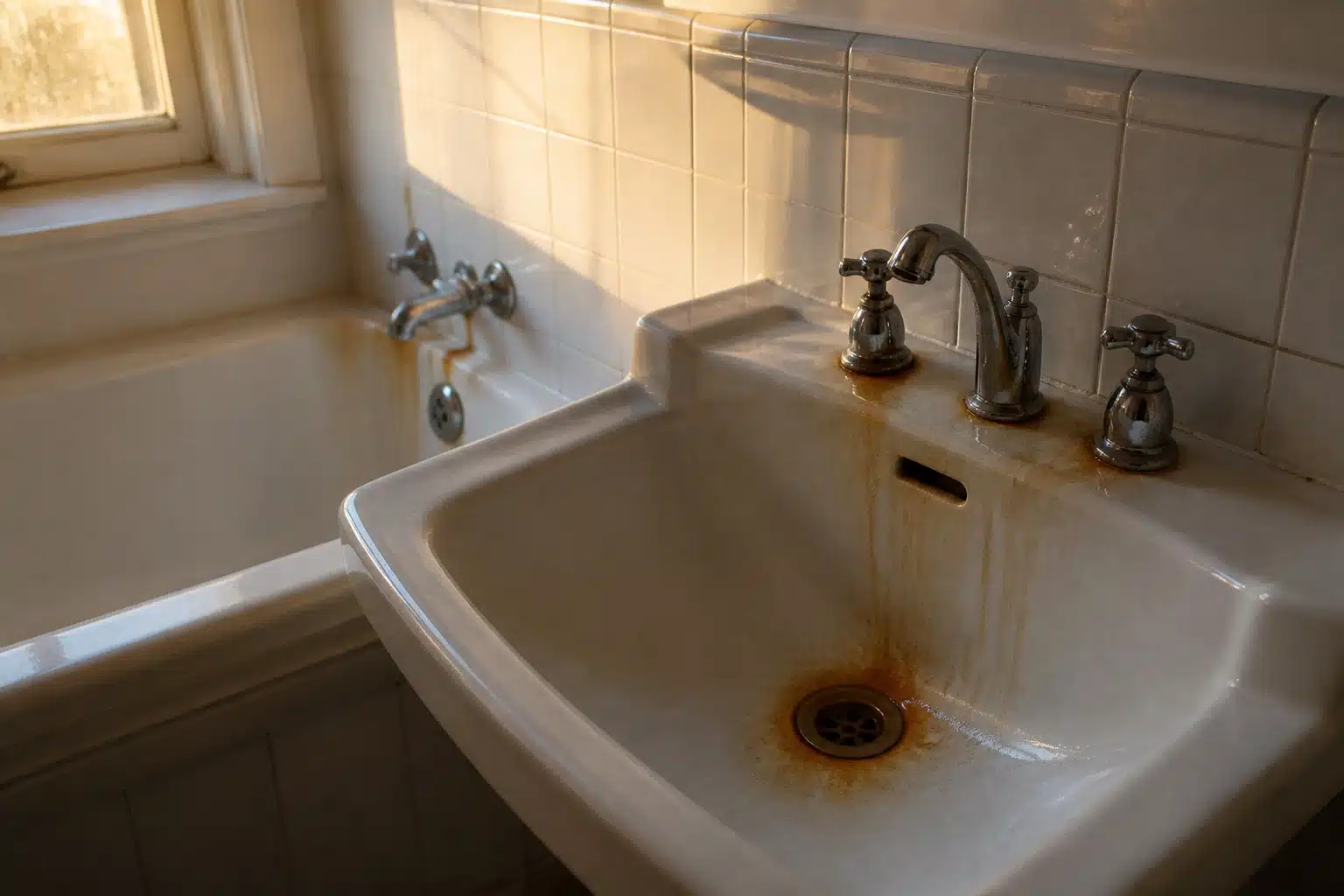
The symptoms themselves are diagnostic if you know how to read them. Sorting them out before anyone quotes you equipment saves a great deal of money:
- Clear at the tap, orange after standing: dissolved ferrous iron oxidizing on contact with air
- Orange or red straight from the faucet: ferric iron, already oxidized and present as particles
- Reddish-brown slime in the toilet tank, clogged aerators: iron bacteria rather than iron alone
- Rotten egg odor on hot water only: almost always a water heater anode rod reaction
- Rotten egg odor on both hot and cold: hydrogen sulfide in the well itself
- Black specks and dark staining: manganese, which often travels with iron and needs a higher pH to treat
- Yellow-brown tint that does not settle and does not filter out: tannins from organic matter, which need a different resin entirely
Beyond the visible nuisance, both problems cost money quietly. Iron shortens the life of water heaters, fouls softener resin, stains laundry permanently, and blinds cartridge filters within weeks. Hydrogen sulfide is corrosive to copper and brass, tarnishes silver, and ruins the taste of anything brewed with the water. Neither is regulated as a health hazard at typical concentrations, since both fall under secondary standards that address aesthetics, but the practical impact on a household is real.
Matching the Treatment to the Actual Problem
This is where most money gets wasted. Each technology has a job, and using one outside its range produces disappointment on a schedule:
- Water softener alone: removes modest amounts of dissolved ferrous iron along with hardness, does nothing for hydrogen sulfide, and does nothing for iron that has already oxidized. Push too much iron through it and the resin fouls
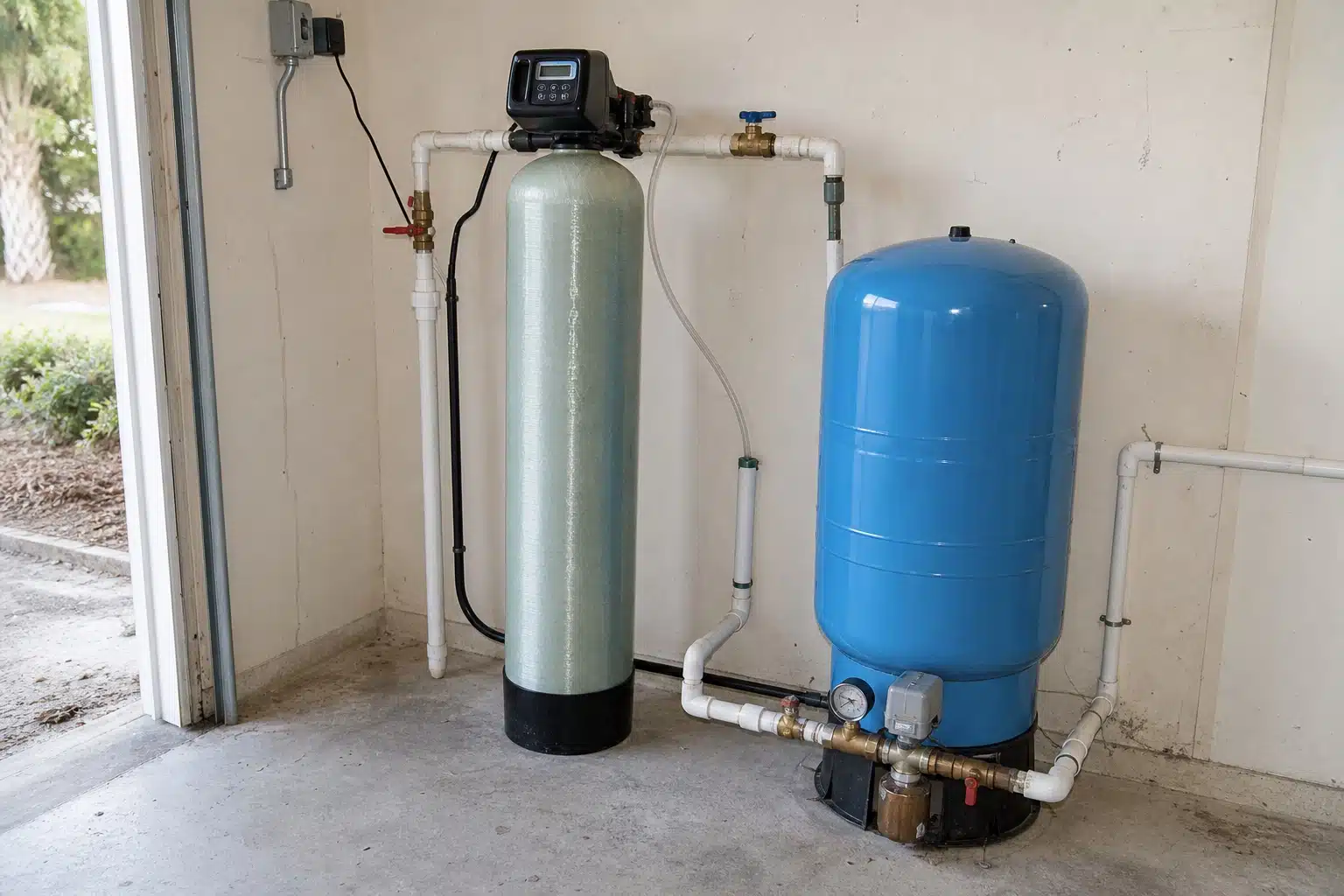
- Air injection oxidizing filter: draws in a pocket of air, oxidizes iron and sulfide as water passes through, then filters the result and backwashes on a schedule. This is the workhorse for combined iron and sulfide on residential Florida wells
- Chemical injection with a retention tank: chlorine or peroxide dosed ahead of a contact tank and a carbon filter. Appropriate for high concentrations, for iron bacteria, and when disinfection is also needed
- pH neutralizer: a calcite tank installed ahead of oxidation when the water is acidic, because low pH cripples every oxidizing filter behind it
- Sediment prefilter: handles sand and grit from the well so the equipment behind it is not abraded
- Point-of-use reverse osmosis: excellent for drinking water at one faucet, not a whole-house answer, and it needs the iron and sulfide removed upstream or the membrane fouls quickly
Sequencing a well water iron sulfur Brevard County treatment train correctly matters as much as the equipment list: sediment removal, then pH correction if needed, then oxidation and filtration, then softening, then point-of-use polishing. Shock chlorinating the well knocks back iron and sulfur bacteria and is worth doing, but treat it as a reset rather than a permanent solution. Components certified to the relevant NSF and ANSI standards are worth insisting on. Our water treatment services start with the test results rather than with a catalog, because the sequence above only works when it is built around what your water actually contains.
What Ownership Looks Like Once the System Is In
Treatment equipment is not a set-and-forget purchase, and knowing the maintenance rhythm up front prevents disappointment. Backwashing filters flush themselves on a schedule and need a drain that can accept the full backwash flow, which is a real design consideration when the system lives in a garage or an outdoor enclosure. Media has a service life, generally several years, and heavy iron loading shortens it. Air injection systems need their air draw verified periodically, because a system that has stopped drawing air has quietly stopped treating.
Well pump output turns out to be part of the equation too. A backwashing filter needs a minimum flow rate to lift and scour its media bed, and a tank sized larger than the pump can support will never clean itself properly. That is why sizing starts with the well and the pump rather than with the number of bathrooms. Plan on retesting the water annually, including the bacteriological screen, and after any work on the well itself. Outdoor equipment near the coast benefits from a rinse and a look at the fittings, since salt air is hard on control valves and bypass hardware. A well water iron sulfur Brevard County system that is sized to the pump and retested annually rarely surprises anyone. Homeowners across Brevard County who stay on top of these few items get many years of quiet service out of a properly matched system.
Frequently Asked Questions
Why does my well water smell like rotten eggs only on the hot side?
That pattern usually points at the water heater rather than the well. The magnesium anode rod that protects the tank can react with sulfate in the water to produce hydrogen sulfide inside the heater. Switching to an aluminum or zinc alloy anode, combined with flushing and disinfecting the tank, resolves most of these cases without any whole-house treatment at all.
Will a water softener remove iron and sulfur from well water?
A softener handles hardness and can carry a modest amount of dissolved ferrous iron along with it, but it does nothing for hydrogen sulfide and nothing for iron that has already oxidized into particles. Asking a softener to do that work fouls the resin and shortens its life. Sulfide and meaningful iron loads need an oxidizing filter ahead of the softener.
How often should private well water be tested?
At least once a year for bacteria, nitrate, and the parameters relevant to your known issues, and any time the taste, odor, or color changes noticeably. Retest after any repair to the well, pump, or casing, and after significant flooding. Private wells are not covered by public system monitoring, so the testing schedule is entirely the owner’s responsibility.
Can existing iron stains in the tub and toilet be removed?
Yes, with an acidic or oxalic-based cleaner made for rust rather than a standard bathroom cleaner, which tends to set the stain. Clear the water problem first, though. Scrubbing fixtures while untreated water keeps arriving is a repeating chore, and the stains return within weeks. Once the treatment system is handling the iron, a single deep clean usually holds.
If your well water is staining fixtures or carrying an odor, our team at Inlet Mechanical can test it, interpret the results, and recommend equipment matched to what the water actually contains. Call us at (321) 723-0858 to arrange a visit, or read more on our water treatment services page. We would rather size the right system once than sell you a second one in three years.
Talk to a Licensed Inlet Mechanical Pro
Whether it’s a repair, an upgrade, or a question, our team is ready to help homeowners and businesses across Brevard & Indian River County.
Licensed FL Mechanical (CMC1250858) · 85+ years combined experience · Free, no-obligation estimates
Written & Reviewed By
Inlet Mechanical Team
The Inlet Mechanical team brings over 85 years of combined experience in HVAC, plumbing, and mechanical construction across Florida. Our licensed professionals hold Florida Mechanical HVAC License (CMC1250858) and Florida Plumbing License (CFC1433105), along with EPA Section 608 certifications. Based in Brevard County, we serve residential, commercial, and industrial clients with expert knowledge of Florida building codes, climate-specific HVAC solutions, and local plumbing requirements. Every article is reviewed by our licensed technicians to ensure accuracy and practical value for Melbourne-area homeowners and businesses.
Last Updated: July 28, 2026